Category Archives: Ceramics

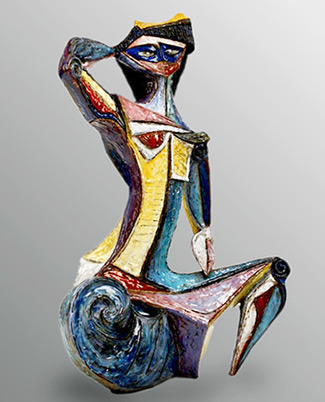
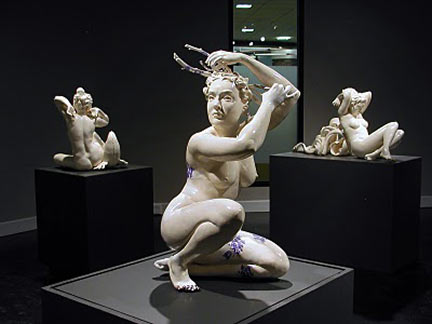
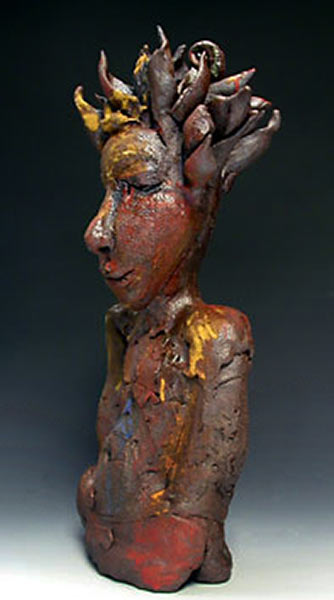
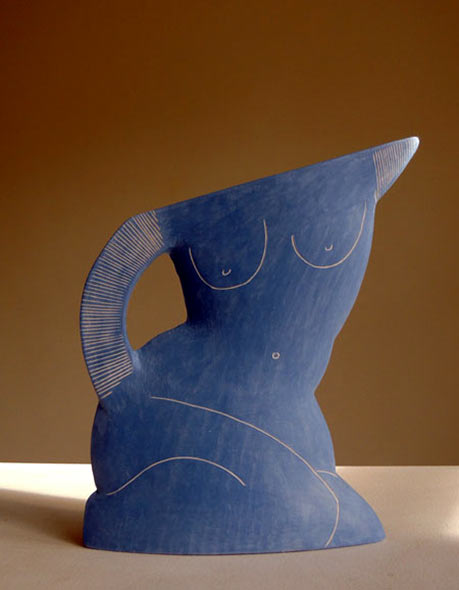
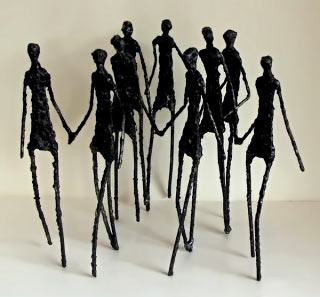
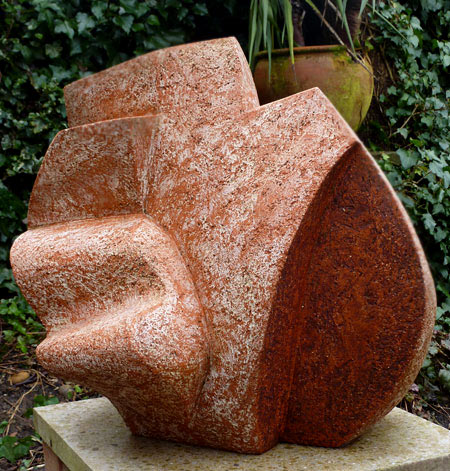
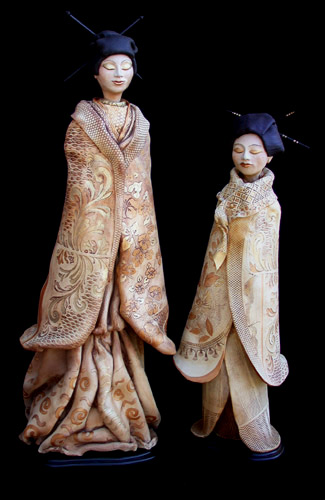
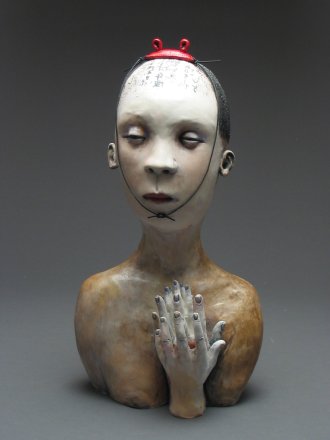
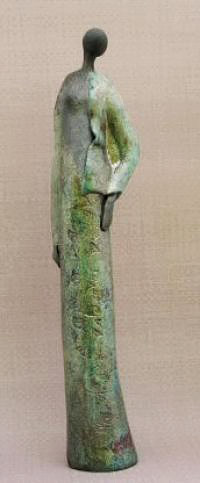
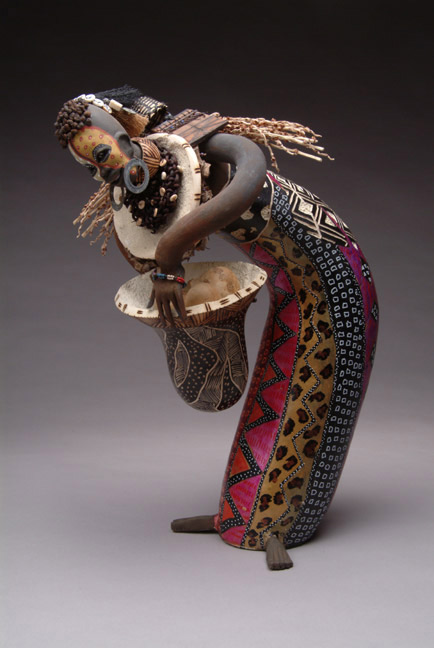
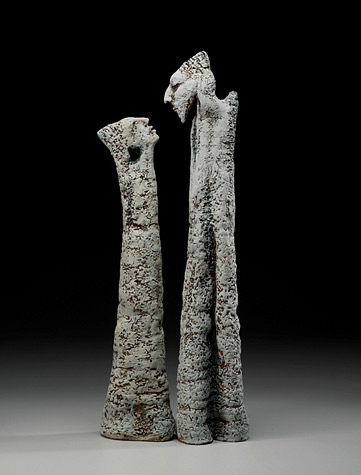
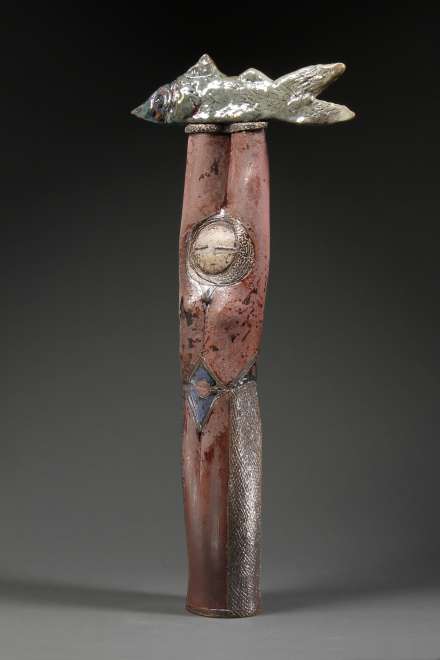
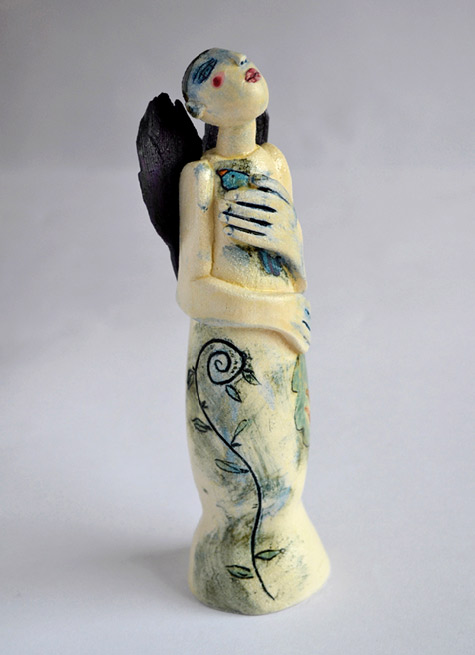
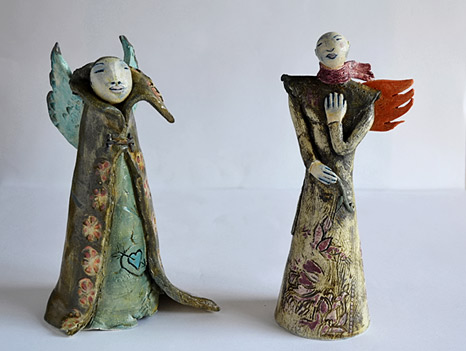
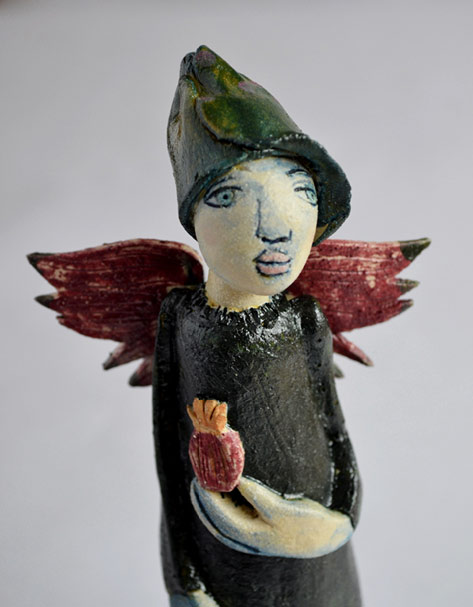
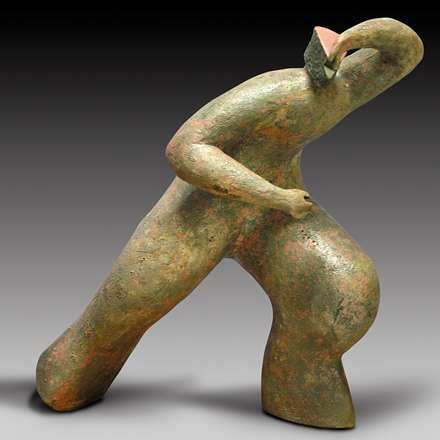
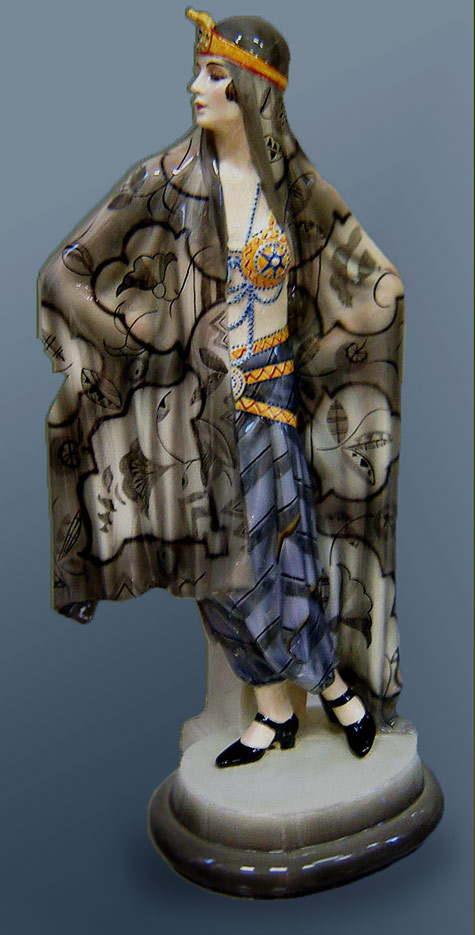
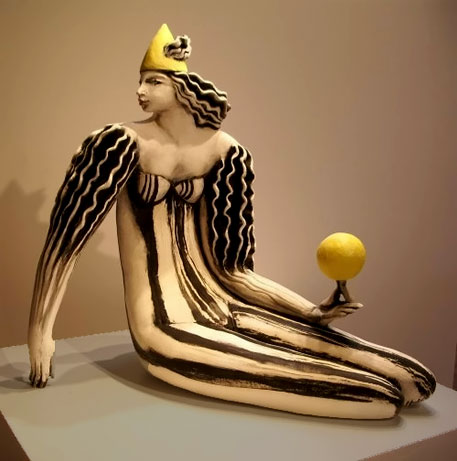
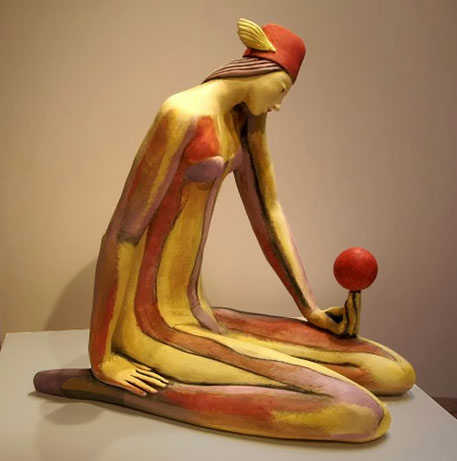
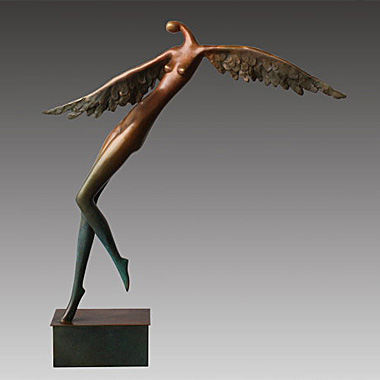
figurative clayart sculptures


From the first time neanderthal man held aloft a lump of clay contemplating what he could use it for, he more then likely posed the question …  functional or decorative?  ” Will I make a bowl for eating my nuts and berries or should I indulge my creativity and make a clay statue of my beautiful wife. How about a sun-dial so I don’t sleep in.  Maybe I could do some raku, but first I have to figure out how to make fire….”
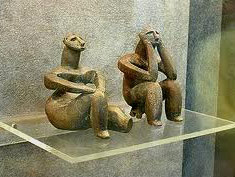
On a more serious note, clay figures have been around for a very long time and I speculate that their earliest use would have been for some kind of idolatry.

The figure sculptures of  Greek Antiquity were not naturalistic, for their forms were idealized and geometric. Figurative art is itself  based upon a tacit understanding of abstracted shapes.This has been referred to as the ” Egyptian method ” where there was an  adherence to that which was already known, rather then what was being witnessed. This  idealization eventually gave way to observation, and a figurative art which balanced idealized geometry with greater realism was seen in Classical  sculpture by 480 B.C. This reliance on visual observation was known by the Greeks as ” mimesis “. This style of figurative art , characterised by attempts to reconcile these opposing principles, remained until the time of the Impressionists.

A figurine is a statuette that can represent a human form, a deity or an animal, and can be either  realistic or iconic.  The earliest were made of stone or clay, and later versions were made with ceramics, metal , glass and wood.

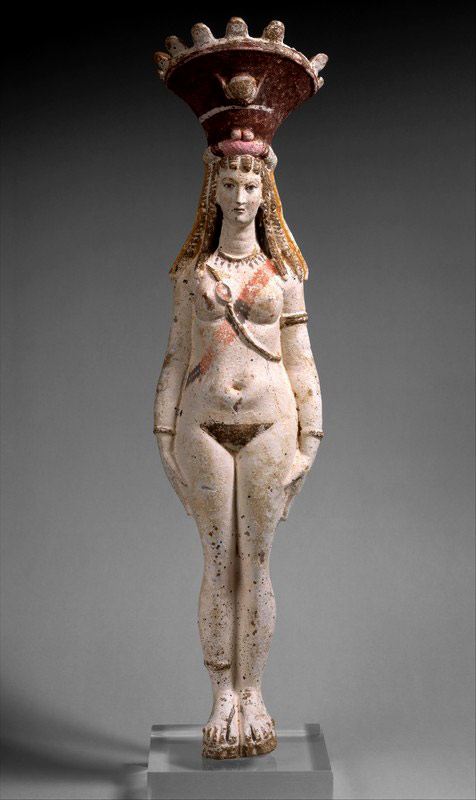
Terracotta Isis

This terra-cotta figure is in honor of the goddesses Isis and Aphrodite.

(  Metropolitan Museum of Art in New York. )

The most common materials for figurines were porcelain and various ceramics.. There are many early examples from China where it originated, which drove  experimentation in Europe to replicate the process. The first European porcelain figurines, produced in a process mastered in Germany were known as Meissen ware after the city where it began.

The ushabti was a funerary figurine used in Ancient Egypt. Ushabtis were placed in tombs among the grave goods and were intended to act as substitutes for the deceased, should he/she be called upon to do manual labor in the afterlife. They were used from the Middle Kingdom (around 1900 BC) until the end of the Ptolemaic Period nearly 2000 years later.
Most ushabtis were of minor size, and many produced in multiples – they sometimes covered the floor around a sarcophagus. Exceptional ushabtis are of larger size, or produced as a one of-a-kind master work.
The ushabtis were servant figures that carried out the tasks required of the deceased in the underworld.

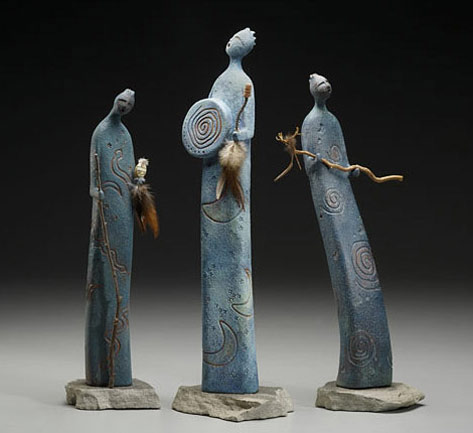
Here is a collection of figurines ranging from ancient to modern :

Kate Gardiner - odyssey-center

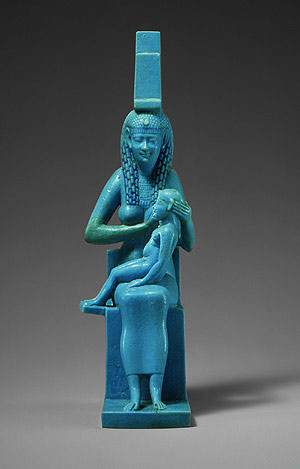
Isis and Horus Statue

Isis and Horus

Lidija Tkalcevic – ACGA  ↓

Lidija Tkalcevic figurine

Cheryl Tall Osirus Clay Statue

Osirus  2010 – Cheryl Tall

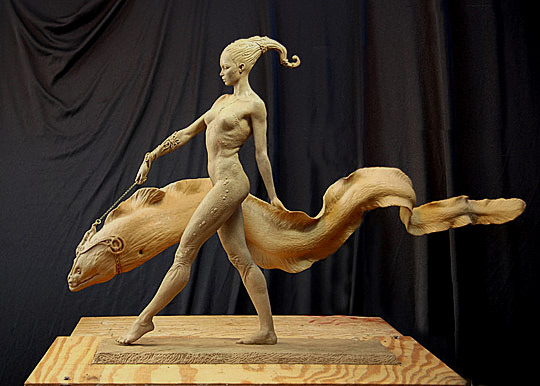
Eel Walker – Mark Newman

This sculpture was eventually cast in bronze.

Artful Ceramics

)Charlene Doiron Reinhart

Charlene Doiron Reinhart

liz bryant ceramic figurative sculpture

Liz Bryant

the buddhabuilder

the buddhabuilder

figurative sculpture

Windy by Piotr Konsk

NEW YEARS DIVA 2 by Nicole West

NEW YEARS DIVA 2 by Nicole West

Russianhead

Patricia Boyd  ↓

Tribal Stand

boyd kindred spirits sculpture

Kindred Spirits 11

Blessed Harvest - Patricia Boyd

Contemporary Sculpture

” Can you see me ”  Adele Macy

Virginia Rigney

Marina Bauguil  

ceramic figure HeartBird

Heart Bird – Marina Bauguil

marina bauguil ceramic figure

Group

Tree Spirit

Obsedian ceramic-figure

Obsedian ceramic-figure

Fred Yokel

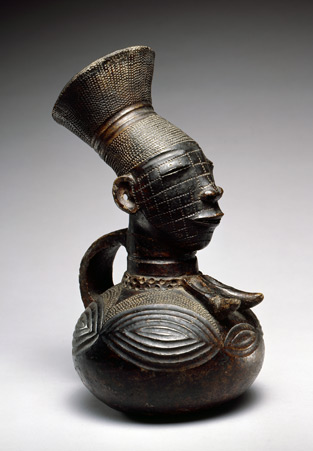
Female Effigy Vessel

Democratic Republic of Congo. Mangbetu. Early 20th century

At the time, elongated foreheads were considered highly attractive. To achieve this look, royal women wrapped their heads with rope and wove their hair into a conical basket structure.

Sherri_K_McEuen ceramic figure

“Dynasty Ceramic Sculpture”

Sherri K McEuen

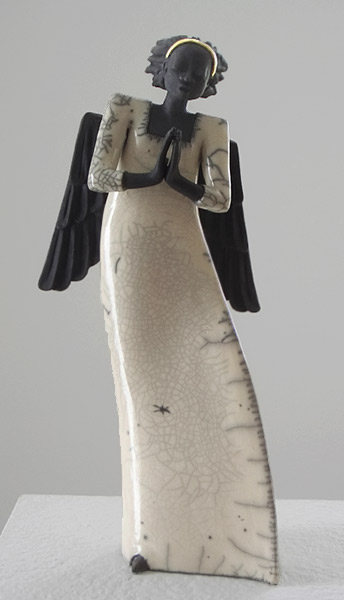
Engel Raku Keramik figure

Ceramic Angel Raku Keramik figure

Margit Hohenberger

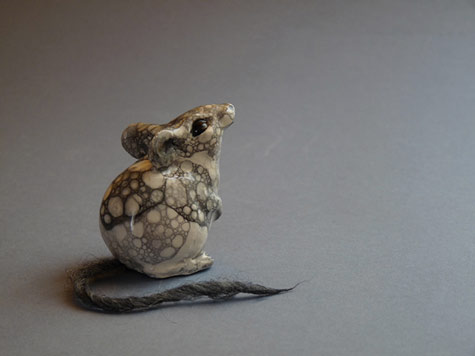
Mouseweb – Michelle hall

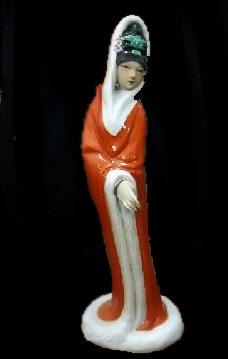
Art Deco Figurine

Art Deco Figurine

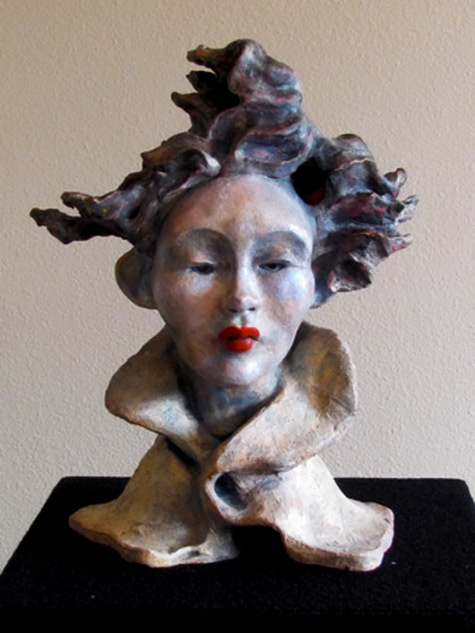
Whisper – Marina Bauguil

African Figurine

Shrine Figure - Nigeria, Ekiti ( Ikiti), Yoruba people,  Late 19th century

De Young Museum


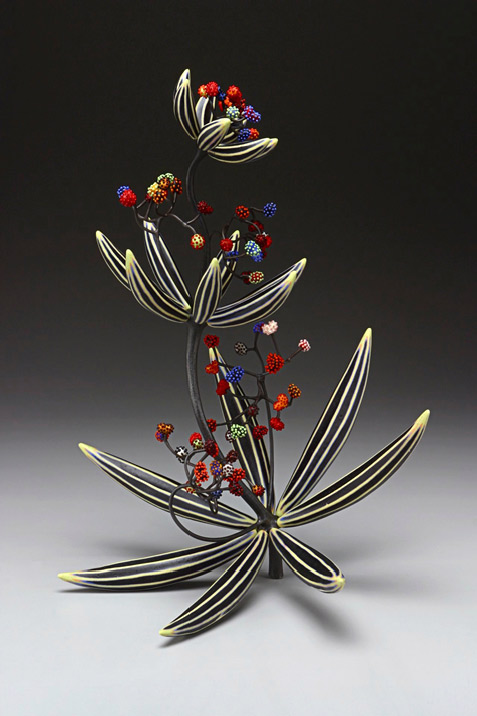
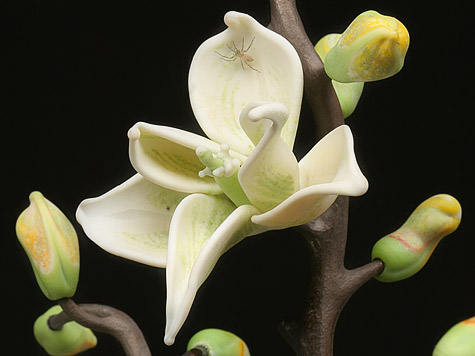
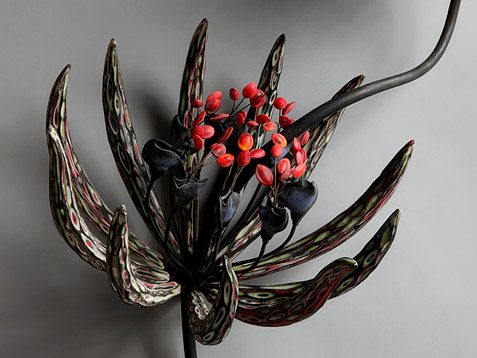
Michael Sherrill, NC ceramicist


Dream of Wildflower


” My desire is to create something that might bring the observer to this same place of wonder. For me to respond to a stimulant and then to make it work is one thing, but its another for that work to make the next step and draw a likewise response from the viewer. “an extract from Michaels artistic statement.

Gifted ceramicist Michael Sherrill draws inspiration from his rural environment in the mountains of North Carolina where he work and lives. This is elucidated by his observation : ” I am compelled by the sensation of seeing things fresh, as if for the first time: like waking from sleep and being surprised by all that surrounds me. In my case, I see the flora and fauna outside my studio, and among them are discoveries and epiphanies.”

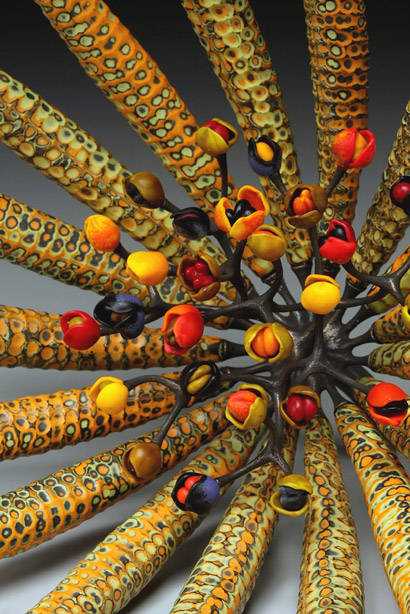
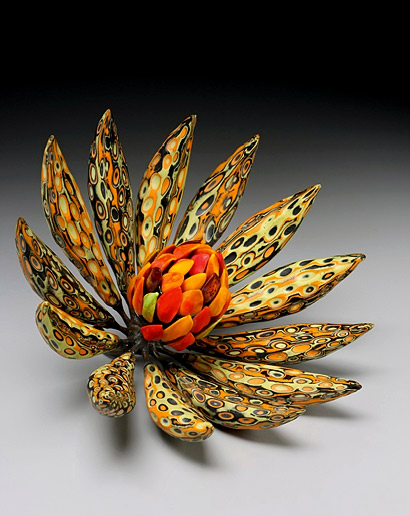
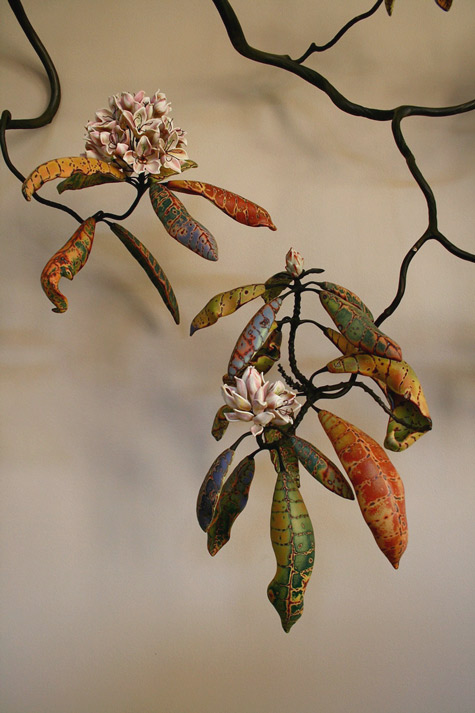
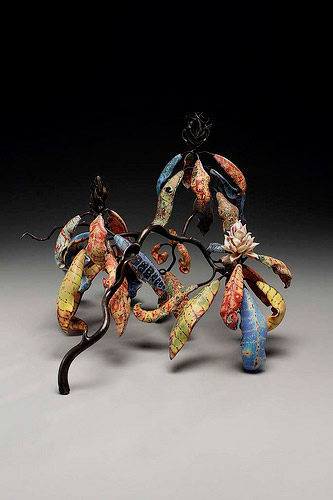
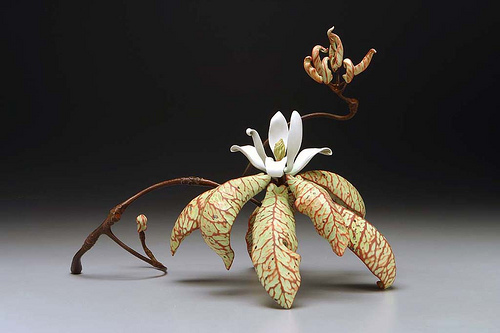
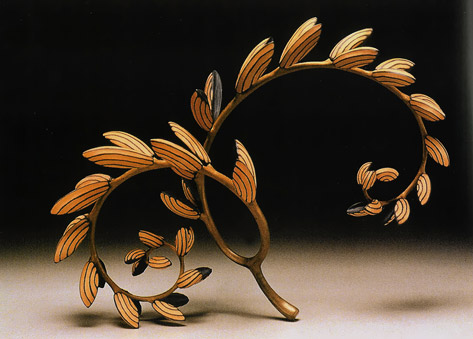
His life-like plant sculptures depict a natural fluidity, texture and detail that breathes subtlety and realism into his flora creations. He achieves this by combining porcelain,moretti glass and bronze in his nature sculptures. Their organically patterned, multicolored surfaces involve a painstaking process of layering and abrading and require four kiln firings. In the interest of “expanding what clay can do” Sherrill has introduced metal into his sculptures: “ “How do I draw with small pieces of porcelain? Metal becomes the backbone for a line or an idea that I want to express.” He has also introduced glass for its color and its heightened translucency

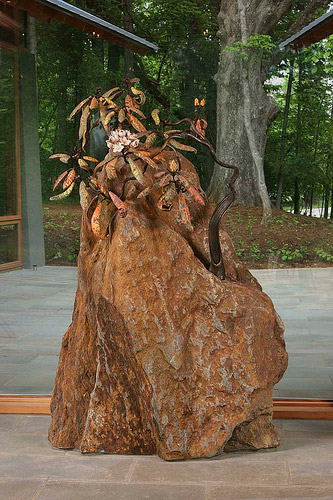
In the example below the leaves are from moretti glass  ( a specific type of colored glass rod that is melted to create patterns in glass ), the central stamen is porcelain and the branches are bronze.

Night Moderne

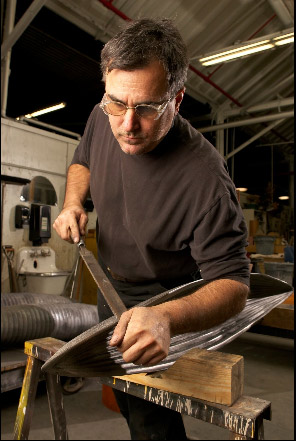
Essentially  a self taught artist, Michael Sherrill moved from Charlotte, North Carolina to the Western North Carolina mountains in 1974. His primary influences came from being in the proximity of the North Carolina folk pottery tradition and the community surrounding Penland School of Crafts and the Southern Highland Handicraft Guild. Specific individuals who have influenced significantly his development include Cynthia Bringle, Don Reitz and Sid Oakley.


Michael Sherrill


Along with being  an artist, Michael also lectures and  is the creator of Mudtools, which was born out of a need to develop a line of innovative clay tools for himself,  which he has also made available to other ceramic artists. Maybe this influence came from his father who was a self-taught inventor who patented industrial processes and created machines.


A collection of  ceramic works from Michael Sherrill :

Descending Rhododendron

Fire Within, 2008, Night Flowers series, silica bronze Moretti glass, mokume porcelain.

Alma’s Weed, 2003

silica bronze, Moretti glass, porcelain with abraded glaze.

Temple of the Cool Beauty

Yucca, detail, 2006, silica bronze, Moretti glass, porcelain with abraded glaze

Sea Flower, Julesvernium

Flourish Rhododendron, 2008

Extruded, Temperature : Cone6, Glazing/Surface finish : Electric Oxidation


Undressed Magnolia  2003

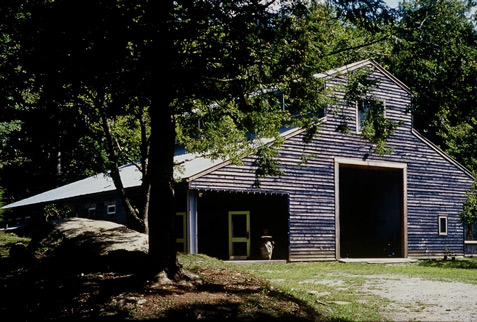
Michaels 5,000-square-foot barn studio.

 ” Beauty in a Hard Place “

( rhododendron growing from a rock sculpture )

The Ramble, Asheville, NC

Michael Sherrill link here


.


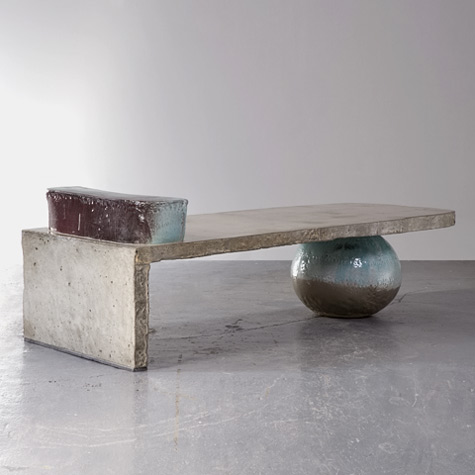
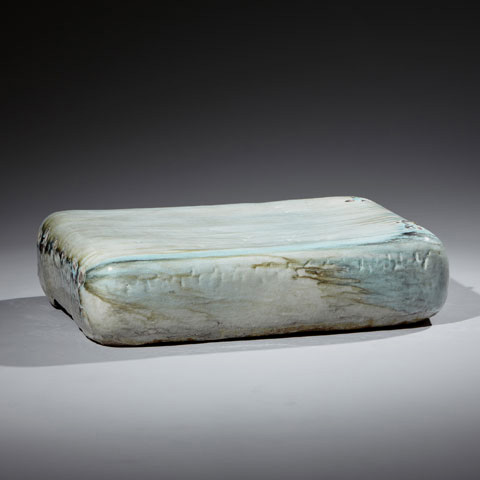
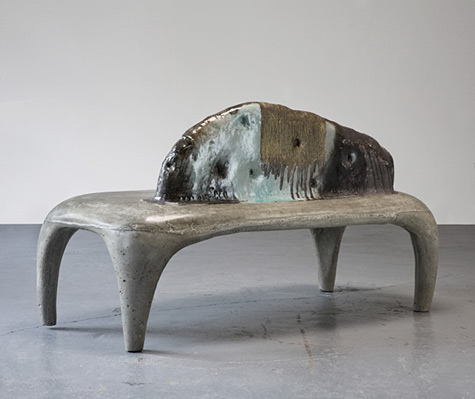
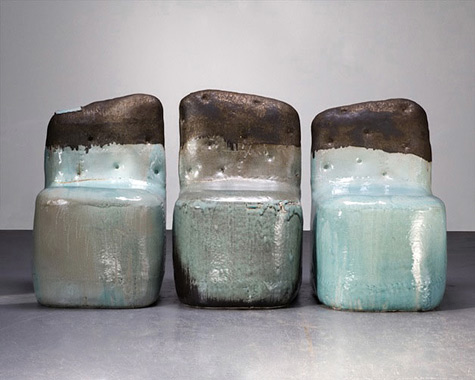
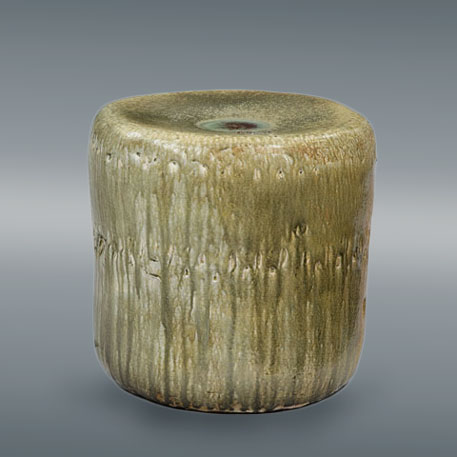
The Ceramic Furniture of Hun-Chung Lee

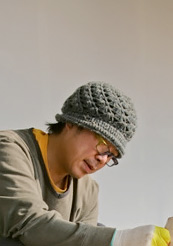
Sth. Korean Designer Hun-Chung Lee :


After receiving his BFA and MFA in ceramic sculpture from Hongik University in Seoul, Lee came to the United States to obtain a second MFA in sculpture from the San Francisco Art Institute, staying on as a teaching assistant for a year after graduation. He is currently pursuing a PhD in Architecture in Korea. His work has been exhibited widely throughout Korea and in the United States.

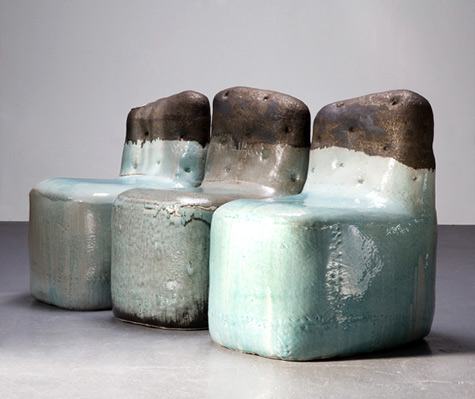
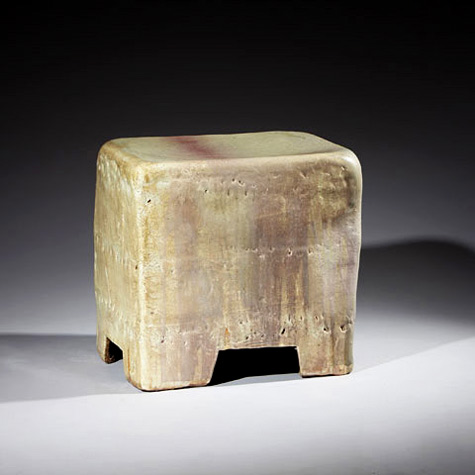
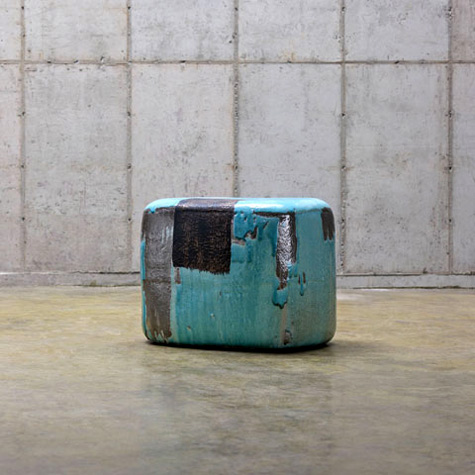
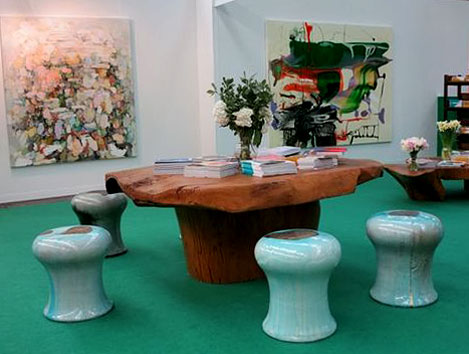
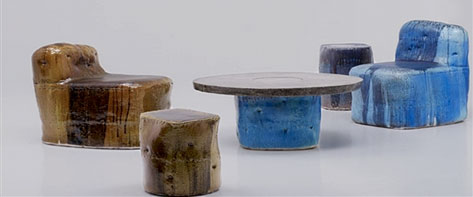
In his magnificent, unique ceramic stools and objects, the seemingly chaotic pattern of glaze belies Lee’s careful, painterly control of palette that emerges upon closer observation. In Lee’s hands, the solid ceramics — as with other materials — take on a soft, almost cloud-like character.

Through exceptionally skilled handwork and applied layers of patina, Hun-Chung Lee transforms materials often considered cold — such as concrete and steel — into architecturally graceful, soft-edged sculptural furniture.

Ceramic couch Hun-Chung Lee

Bench by Hun-Chung Lee

CEramic Chairs Hun-Chung Lee

Chairs by Hun-Chung Lee

About the artist:

Lee’s interests in the historic precedents of Korean decorative arts and cultural heritage encourage him to celebrate the natural poetry of his materials in a way rarely seen in Western design. Many of the high-fired ceramics in the exhibition feature a celadon glaze originally developed during the 15th century. Lee also uses a traditional, hand-built kiln and relishes the unpredictable nature of the glazes over the course of the several days of immersing, pouring and firing that it takes to produce each piece. He presents the collection of works as a collaboration with and homage to nature. His delicate colors and simple forms are intended to suggest the natural beauty of the Korean landscape throughout the changing seasons. A recurring theme in this new collection is harmony — the harmony of colors and the harmony of seemingly disparate materials in his benches and storage units. In these pieces Lee coaxes concrete and steel into shapes that are softer than seems possible from such traditionally hard materials.
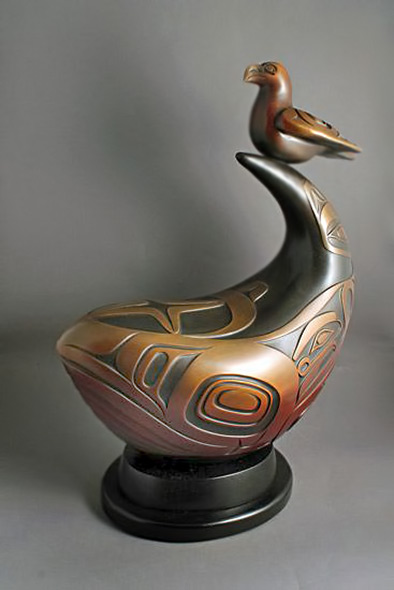
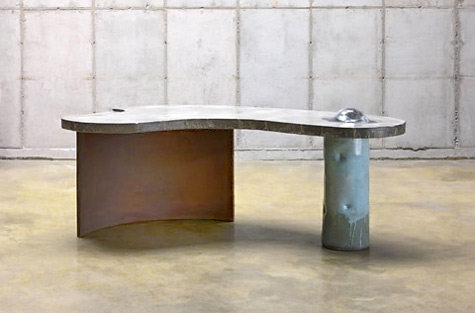
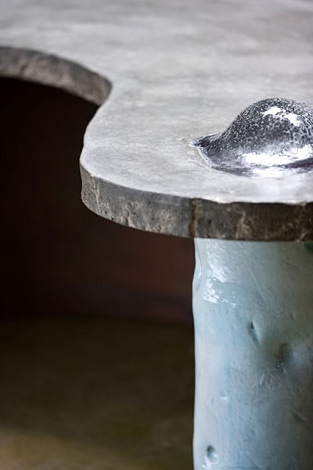
Ceramic,concrete,steel desk Hun-Chung Lee

“Organic Lined Concrete Desk,” concrete, glazed ceramic and natural rusted steel.

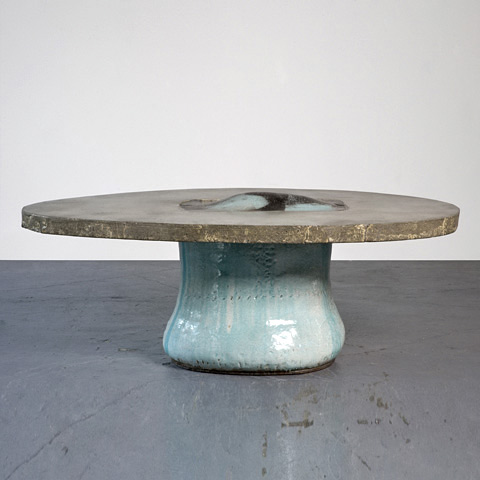
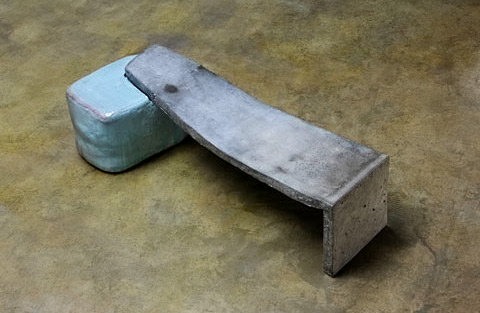
Low table in concrete and ceramic.Hun-Chung Lee

Low table in concrete and ceramic.

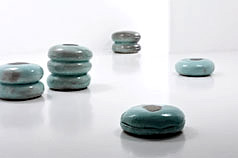
ceramic glazed stool

Ceramic stool in a pale colored glaze with a red band

Foot Stool ceramic

“Silver Brushed Ceramic Stool in Sky Blue,” glazed ceramic.

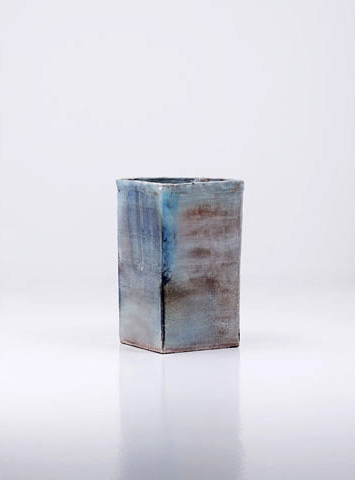
"Skyblue Garden" vessel in glazed ceramic.

“Skyblue Garden” vessel in glazed ceramic.

An extract from an essay by Yun-chung Lee :

” Whenever I saw a sculptor’s work resembling a lump of clay or a bowl, I used to try to find out the artist’s intention. In the past when I created a piece I used to try to convey the meaning and the function of the project to spectators. However, there came a point in time, I don’t remember exactly, when I began to see a sculptor’s work without the need to understand the artist’s intention. Presently, I try to escape from the pattern of  [planning and following the plan], in my work because I have come to realize that forcing spectators to understand the artist’s intention and forcing artists to explain the work is a sort of intellectual violence, which blocks the flow of emotion in my heart. When I am freed from the obsession of the result of my creation, my freedom can give light to the memories in my heart so that I can re-live a spiritual journey.”

“ For me, the world is like a swift current, while the inside of my body is calm pond. “

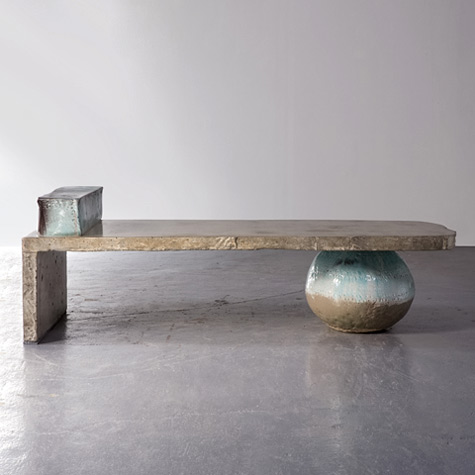
Ceramic Bench Hun Chung Lee

“Concrete Day Bed with ceramic Pillow and Jar,” concrete and glazed .

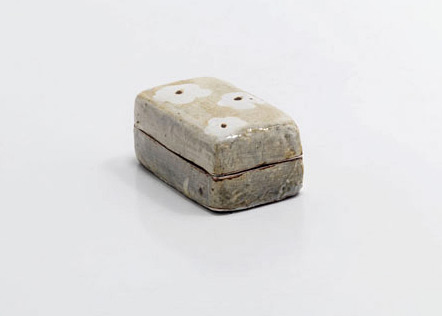
Ceramic Box

“Small Beige Square Ceramic Box with a Lid in Plum Flower Motif,” glazed ceramic.

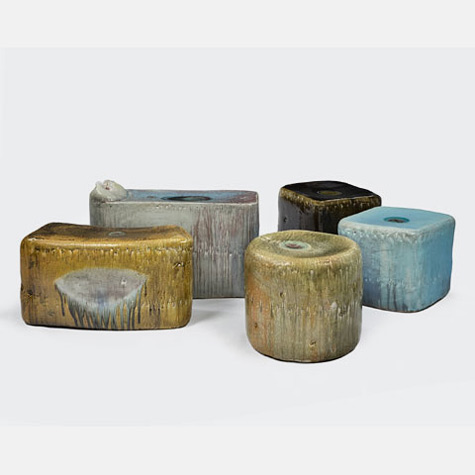
Ceramic Stools

Ceramic Stools

Ceramic and concrete Bench

Low ceramic stool with pale blue glaze.

Ceramic Bench Hun -Chung Lee

From March 6th through April 28th 2012, the most outstanding works of Hun-Chung Lee will be on show at the R 20 gallery space in the Tribeca neighborhood of New York.

Yun-Chung Lee

Archie Bray Foundation for the Ceramic Arts.

The Archie Bray Foundation for the Ceramic Arts is located near the foothills of the Rocky Mountains in Helena, Montana, on the grounds of what was once Western Clay Manufacturing Co. brick manufacturing company. Bray, an avid patron of the arts, envisioned an art center and built the Pottery centre  in the spring of 1951, the first step in his dream to ” make available for all who are seriously interested in the ceramic arts, a fine place to work.”

The foundation is a  nonprofit, educational institution founded  by brickmaker Archie Bray. ” Its primary mission is to provide an environment that stimulates creative work in ceramics.”

Probably the most important reason for coming to the Bray is the opportunity to work within a community of artists actively creating art. At the Bray, artists from around the world with a vast range of experiences and diverse aesthetic approaches, cultures and perspectives come together. Sharing discoveries, frustrations and triumphs, and working together over an extended period of time establishes friendships and connections that open new paths, develop careers, and change lives.

Since its inception, the Bray has drawn more than 200 ceramic artists from around the world to work, including such well-known ceramists as Tre Arenz, Val Cushing, John and Andrea Gill, Wayne Higby, Clary Illian, Jun Kaneko, Eva Kwong, Jim and Nan McKinnell, Ron Meyers, Robert Sperry, Chris Staley, Akio Takamori, and Arnie Zimmerman.

Some current artists at Archie Bray :

Andrew Martin-

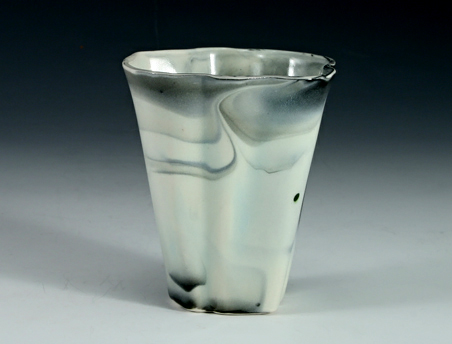
Andrew Martin currently lives in the Netherlands and earned his BFA from the Kansas City Art Institute and his MFA from Alfred University in New York. He has been a resident at the Archie Bray Foundation and the Arts-Industry Program at the Kohler Company, and was awarded two Artist Fellowship Grants from the National Endowment for the Arts. His book, “The Essential Guide to Mold Making and Slip Casting” has become the standard text on the subject.


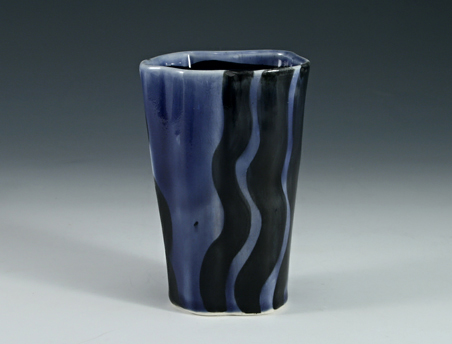
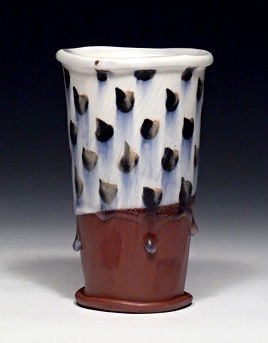
Andrew Martin tumbler
 Marbled tumbler


Andrew Martin tumbler


Lorne Meaden -

Lorna grew up in the western suburb of Chicago, La Grange. After receiving a B.A. from Fort Lewis College in 1994, she established a studio in Durango, Colorado. She worked as a studio potter for the next eight years. She received an MFA in ceramics from Ohio University 2005. She has recently been a resident artist at the Archie Bray Foundation.

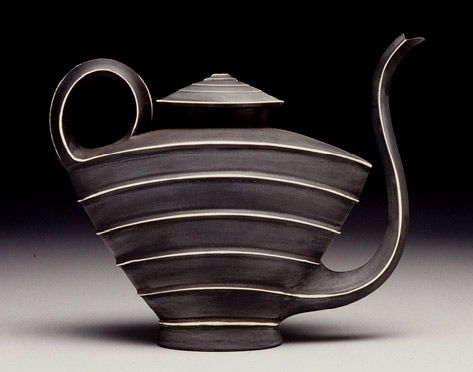
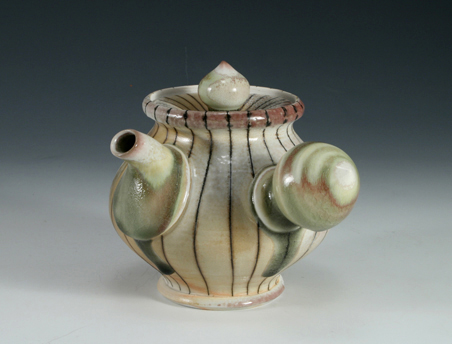
Lorna Meaden Teapot

Lorna meaden


Jeff Campana -

I draw lines by dissecting and immediately reassembling each pot. The result is a surface decoration with structural implications. The fault lines that decorate the surface threaten to, but do not actually undermine the vessel’s ability to contain, display or deliver.

Jeff Campana Vase

Jeff Campana JarJeff Campana Jar

Mel Griffin- 

     ”I believe that the capacity to empathize can be developed through attentive engagement with daily landscape, and that the health of that landscape affects the health of our minds. In my work, animals serve as both playful and solemn metaphors for my own interactions with the environment, as well as those of society as a whole. Through imagery and metaphor, line and clay, my work seeks to capture the viewer’s emotional interest and to rekindle her sense of wonder and discovery.”
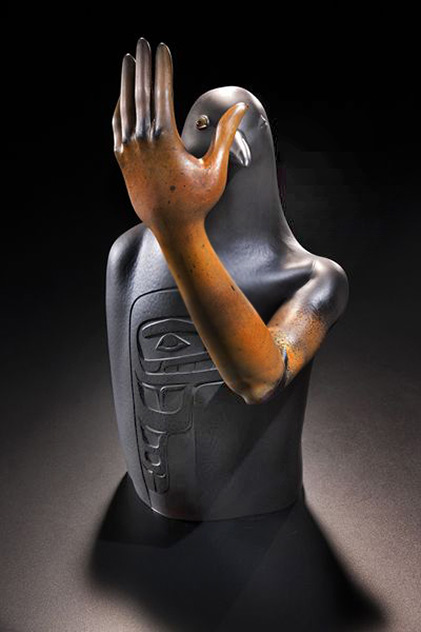
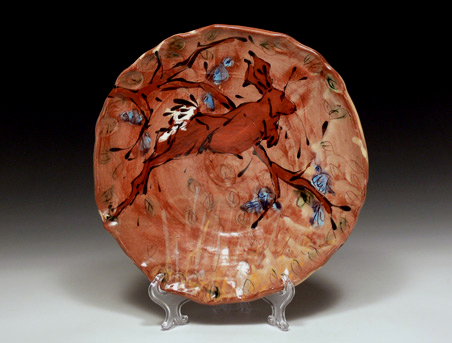
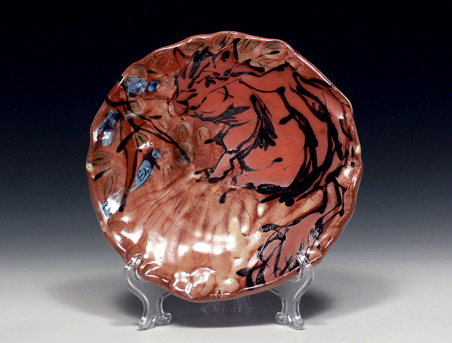
Mel Griffin Salad PlateMel Griffin Salad Plate

Sean O’Connell - 

Sean O’Connell is a functional potter living and working in Helena, MT and currently the 2011- 2012 Matsutani Fellow at the Archie Bray Foundation.

“I make functional pottery based on the idea that beauty and purpose should be a part of everyday use. It is my pleasure to make these objects and my desire to see them in the hands and on the tables of people, who like me, have a passion for that which is tended and thoughtful.”

Sean O'connell 

Melissa Mencini -

Melissa Mencini received her BFA from Bowling Green State University in 2000 and her MFA from Southern Illinois University at Carbondale in 2003. She teaches at the University of Alaska Anchorage. Melissa has also taught at Eastern Washington University and at the University of Washington in Seattle. She was the recipient of the Lincoln Fellowship during her residency at the Archie Bray Foundation. Mencini became interested in art at an early age and enrolled in classes at a local art center in her hometown of Cleveland, Ohio.

She makes pottery embellished with bright designs and decals and also maintains a body of sculptural work.

Melissa Mencini mug

Kenyon Hansen -

“I believe that finely crafted, thoughtfully made pottery can contribute to a renaissance of tradition and habit. My hope is that the pots I make can play a role and be a factor in a renewal of ritual. Clay allows me to play with a physical language. When I throw or hand build, I’m engaged in the conversation, curiosity often pushes the dialog, while the desire to find something new guides me forward. I strive to create pottery that is both considered and balanced containing a healthy dose of spirit and care. “

Kenyon Hansen Jar

Jennifer Allen -

 Jennifer received her BFA from the University of Alaska Anchorage in 2002. In addition to a formal education, she worked full time as a studio assistant for Bliss Pottery from 1998 to 2002. For post baccalaureate study, Jennifer attended Rochester Institute of Technology School for American Crafts from August 2002 until June 2003. In the summer of 2003, she was awarded the Eric Myhre Scholarship at the Archie Bray Foundation in Helena, Montana. In 2006, Jennifer received her MFA in ceramics from Indiana University. Jennifer was awarded the Taunt Fellowship at the Archie Bray Foundation in 2006-7.

Jennifer Allen

Jennifer Allen Vase

Andrew Gilliat -

” I am fascinated how, culturally, we define ourselves and personalize ourselves through the objects we use and accumulate. The clothes we wear, the cars we drive, the shoes we buy- all of these objects reflect our personality and aesthetic proclivity both publicly and privately. Within this body of work I want to provide a framework that allows for the user to search out a bowl or cup that suits their need for function and their desire for aesthetic. With my functional pottery I am designing and fabricating objects in the want of creating visibly dynamic forms that, with the use of color and imagery, are expressive, visually inviting, and easily accessible as objects for domestic use. ”

Andrew Gilliat Bowl

Tom Jaszczak -

Tom received a Bachelor of Arts in Visual Art and a Bachelor of Science in Biology from Bemidji State University. After graduating, Tom apprenticed for Simon Levin at Mill Creek Pottery for a year and learned the process of wood firing and developed his work further. Following Tom he was an artist in Resident at the Cub Creek Foundation.

Tom Jaszczak

Martha Grover -

I seek to enhance the experience of interacting with functional objects. Creating a sense of elegance for the user while in contact with each porcelain piece. Reminiscent of orchids, flowing dresses, and the body, the work has a sense of familiarity and preciousness. Direct curves are taken from the female figure, as well as the fluidity of a dancer moving weightlessly across the floor. The space between elements is electrified with anticipation and tension. I think of the fluid visual movement around a piece, as a choreographer would move dancers across a stage. Transmitting desire- there is a sense of revealing and concealing, a layering of details that serves to catch our attention immediately and then the details draw us in, to make a closer inspection.

Martha Grover Pitcher

◊◊◊

Larry Clark -

For more Archie Bray Foundation information on their artists and programs click here.


Design Innovator – Christopher Dresser


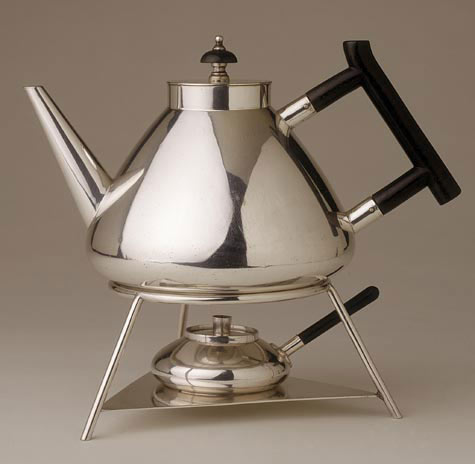
Cristopher Dresser Metal KettleC.Dresser designed metal kettle

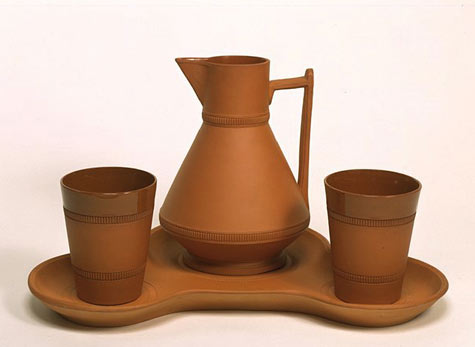
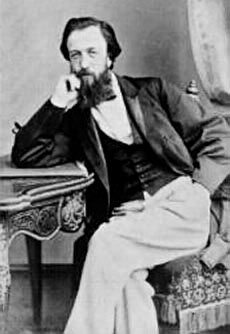
Without a doubt, Christopher Dresser ( 1834 – 1904 ) can be regarded as one of the great pioneers of  modern design. He was among the first independent industrial designers, and he  championed design reform in 19th century Britain while embracing modern manufacturing in the development of wallpaper, textiles, ceramics, glass, furniture and metalware.

During his time,  Dresser was a household name, who was  famed for his innovation in industrial design. He became a force for furnishing ordinary people with well-made, efficient and engaging goods, along with the hundreds of objects he  designed in textiles, wall coverings, ceramics, glassware and metalware. His commercial success is all the more remarkable as Dresser also pioneered what we now recognise as the spruce, simple modern aesthetic. Radical for the time, some of Dresser’s products, notably his 1880s metal toast racks, are still in production today.

Dresser was born in Glasgow in 1834, and from 1847 to 1854 he studied at the Government School of design, Somerset House. Having specialised in botanical studies, Dresser became a lecturer in botany when he left the College in 1854. This study of plants had a profound effect on his approach to design. Seeing nothing superfluous in nature, where every beautiful thing had simplicity of form and a clear function, Dresser applied the same principle to design.

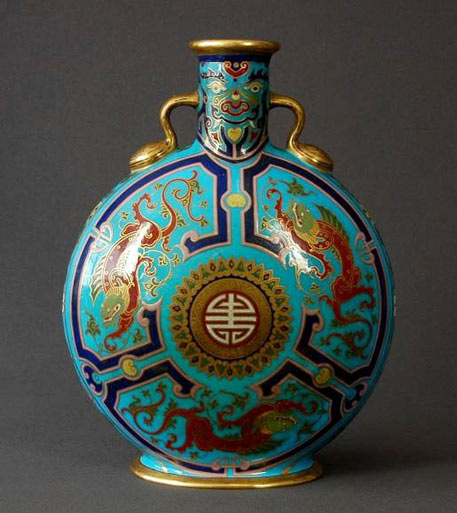
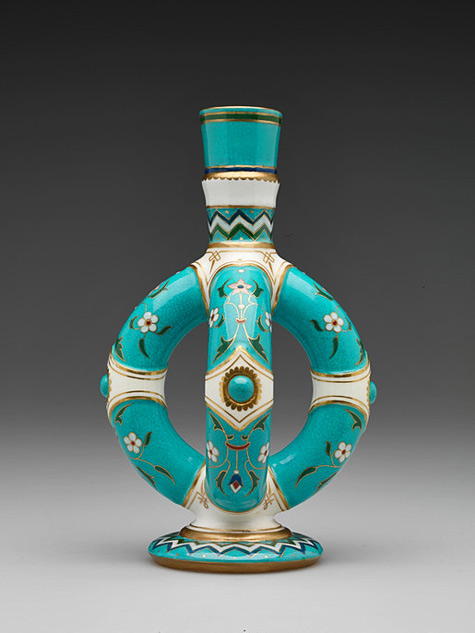
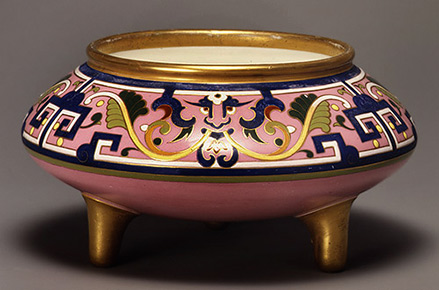
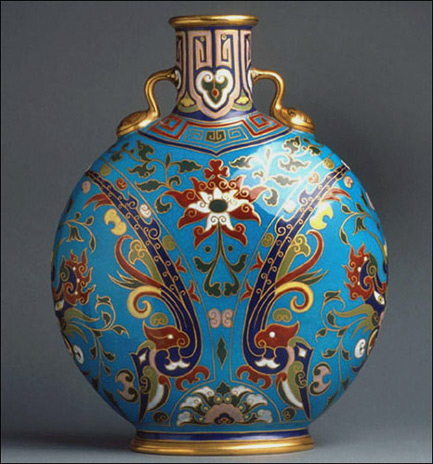
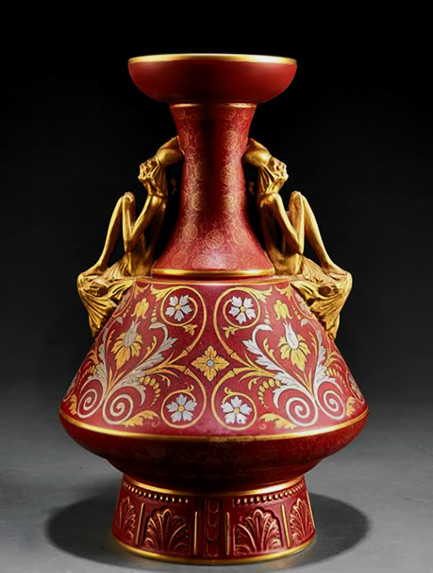
Christopher dresser, porcelain pilgrim flask.Minton & Co, Christopher Dresser, porcelain pilgrim flask. Dragons, masks and geometric decoration.

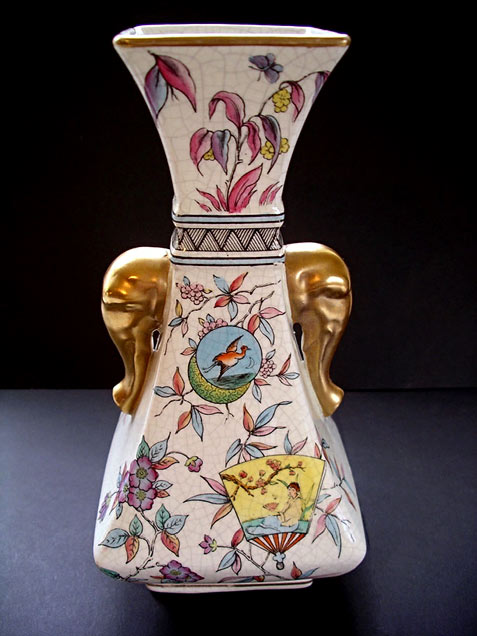
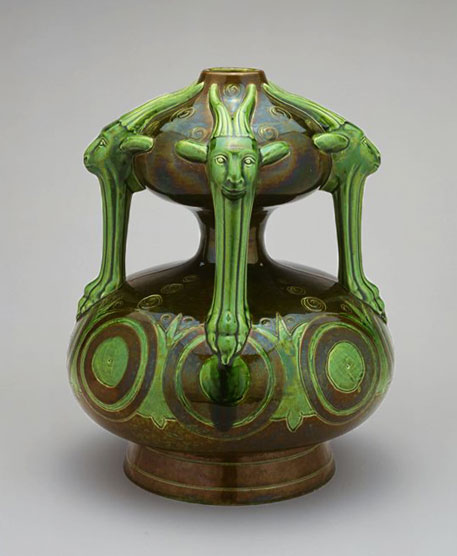
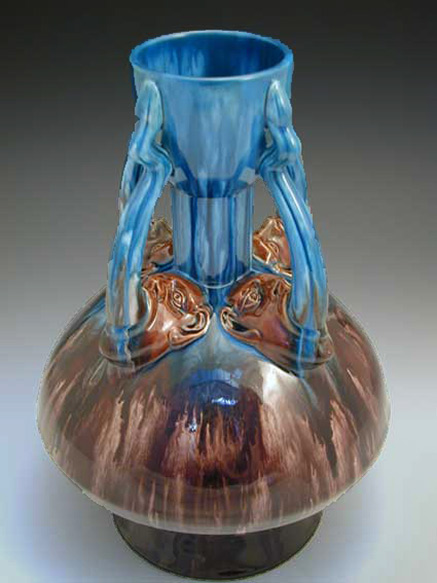
CHRISTOPHER DRESSER OLD HALL JAPANESE AESTHETIC STYLE ELEPHANT HEADS POTTERY VASE

Christopher Dresser  Old Hall Japanese aesthetic style elephant heads pottery vase

In 1876, he became the first European designer to be commissioned to visit Japan, which had reopened its borders in 1854, in order to view craft and manufacturing techniques for the UK government.  As well as lecturing about Japan and Japanese craft techniques on his return to the UK, he published his acclaimed book ‘Japan, Its Architecture, Art and Art-Manufactures’ in 1882.

Dresser’s trip to Japan had a profound effect on his approach to design as well as his understanding of manufacturing processes. Prior to his trip, his output shows a great amount of attention to surface ornamentation. Upon his return, however, Dresser began to take a holistic approach to design. Form and decoration became inseparable.

At a time when the fast-expanding Victorian middle classes were enthusiastically furnishing their homes, Dresser designed all the effects necessary for the family table: claret jugs, tea services, serving dishes, toast racks, candlesticks and cruet sets. Much of Dresser’s most influential work was produced from the late 1870s when he worked increasingly as an adviser and designer to smaller firms which allowed him greater control over a range of products. While he still provided designs anonymously, his stature was so great that many manufacturers now used Dresser’s name as a marketing ploy. He supplied designs to at least fifty companies, both in Britain and overseas.

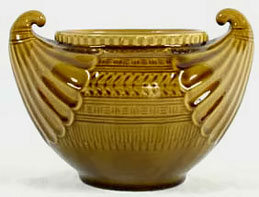
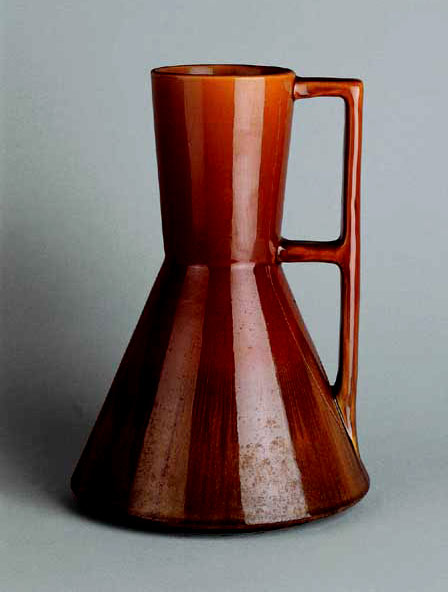
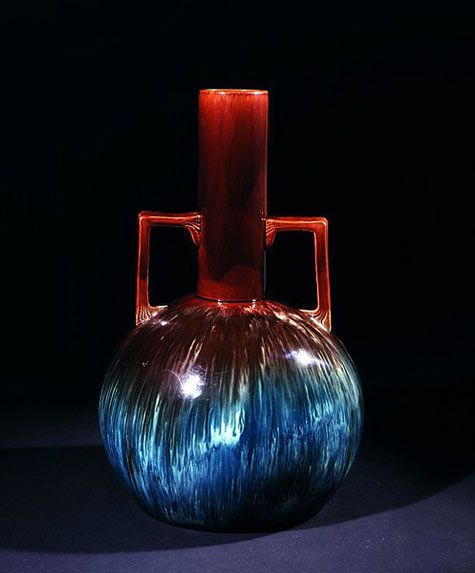
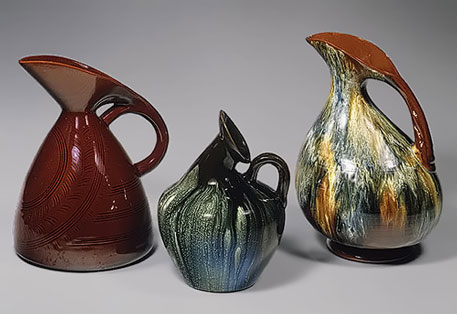
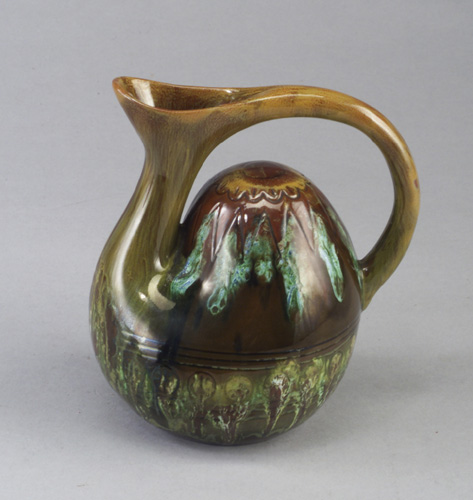
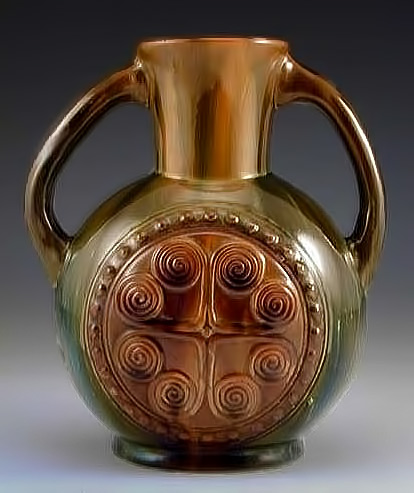
Minoan inspired Pitchers, Christopher DresserChristopher Dresser  Linthorpe Art Pottery pitchers. Pots made by Linthorpe were potted by hand and then finished in a wood mold. Hand painting and glazing were done after the first biscuit firing. Innovative methods, such as spray color and gas ovens, were used. The glaze, possibly made with ground flint or granite added to Cornish clay and oxide tints, created a random yet richly mottled effect that emulates Japanese Raku teawares.


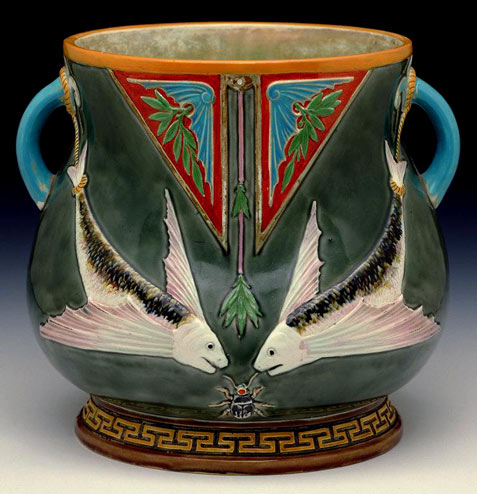
Wedgwood & Sons Aquarian flower potWedgwood & Sons
Aquarian flower pot, 1873, design –  Christopher Dresser

( The Minneapolis Institute of Arts )


Dresser’s designs were radical in the context of a period when many designs combined a heady mix of cultures and periods with the highly decorative Rococo revival style dominating silverware. His reduced, geometric forms revealed the influence of Japanese and Islamic silverware and a desire to be economic with the use of costly materials. Maintaining an acute awareness of function, Dresser also became adept at utilising standardised components for handles and lids to reduce costs for manufacturers.

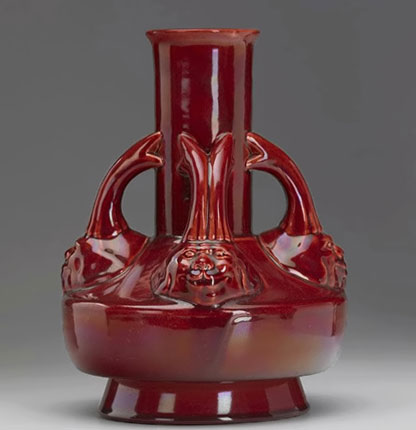
The contrasts in his designs for different materials showed how his approach to design was also shaped by the properties and nature of a material. In 1879 Dresser was appointed art director at the newly established Linthorpe pottery, near Middlesbrough. Founded by John Harrison, the pottery’s aim was to use local clay to provide jobs for local men. Dresser’s design for the moulds for the pottery were inspired by a wide range of cultures from Japan, Peru, Mexico, Morocco and Ancient British forms. These pieces were very striking at the time, with the metal oxides in the complex and innovative glazes providing the only decoration.

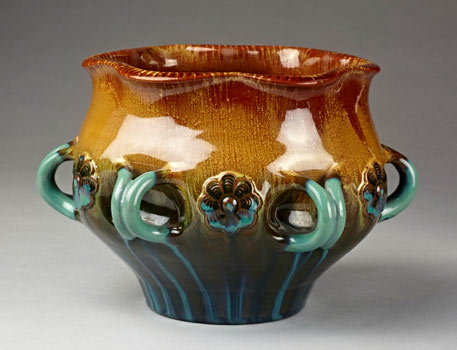
Six-handled bowl of lead-glazed earthenwareLinthorpe Pottery Six-handled bowl of lead-glazed earthenware, design C.Dresser

( The Victoria and Albert Museum )

Watcombe Pottery Co. Glazed earthenware, moulded and gilded vase. Design-C.Dresser ( V & A Museum )

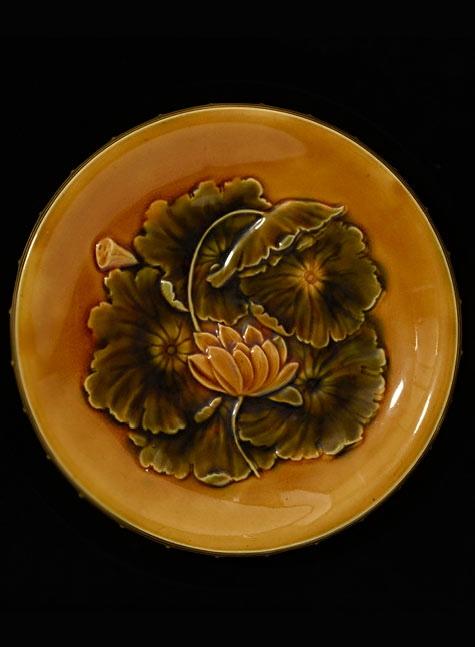
 Lead-glazed earthenware dish . Design - C.DresserLinthorpe Pottery - Lead-glazed earthenware dish . Design – C.Dresser

( The Victoria and Albert Museum )

He also promoted design through his writing and lectures. Speaking to the Royal Society of Arts in 1871 he argued: “True ornamentation is of purely mental origin, and consists of symbolised imagination only… Ornamentation is even a higher art than that practised by the pictorial artist, as it is of wholly mental origin.”

Towards the end of Christopher Dresser’s life, a tribute appeared in an 1899 issue of Studio magazine describing him as “perhaps the greatest of commercial designers, imposing his fantasy and invention upon the ordinary output of British industry.”


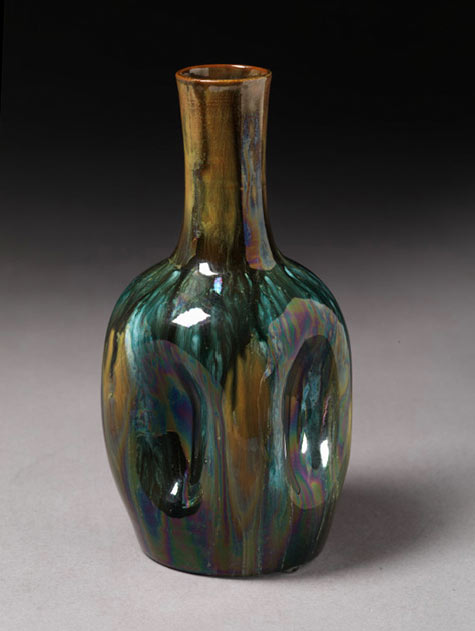
Linthorpe Art Pottery vase. Design - Christopher DresserLinthorpe Art Pottery vase. Design – C.Dresser

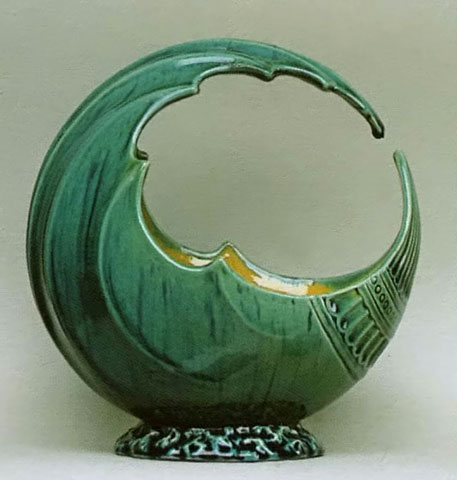
Wave Bowl - Christopher Dresser design Wave Bowl - C. Dresser design, Linthorpe Art Pottery, Middlesbrough

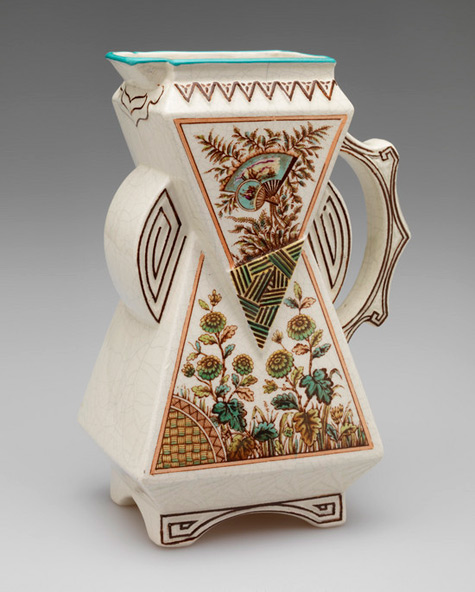
glazed earthenware  jug-C.Dresser 1880 glazed earthenware  jug

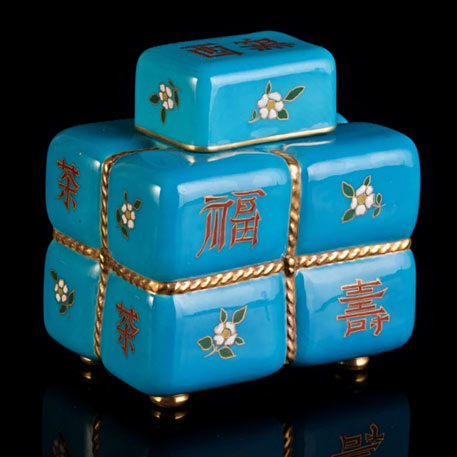
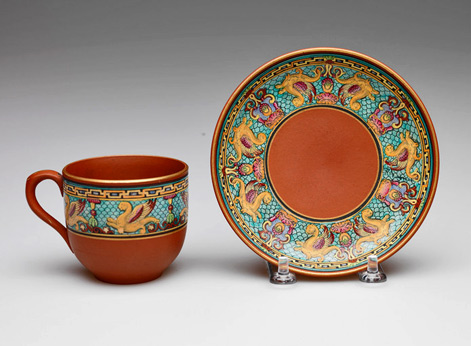
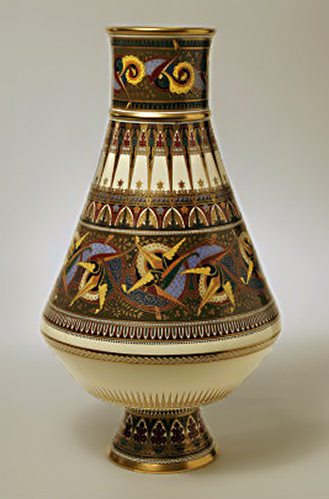
'Cloisonne' tea caddy-C.DresserA ‘ Cloisonne’ tea caddy’, the design attributed to Christopher Dresser, manufactured by Minton & Co. circa 1870

( Walpoles Antiques )


  William Ault Pottery earthenware, moulded and glazed vase. Design C.Dresser ( V & A Museum ) 


Watcombe Pottery Co – Earthenware Jug and Cups
William Ault Pottery Vase C.Dresser design William Ault Pottery-  glazed earthenware vase  ( V & A Museum )

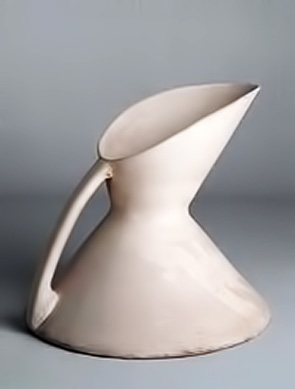
This vase form, based on the sphere and right angle, does indeed appear to preclude 20th-century Modernism. But, as is well established,  Dresser’s appreciation of spare, clean shapes, derives from his interest in Japanese forms and his profound understanding of manufacturing processes.

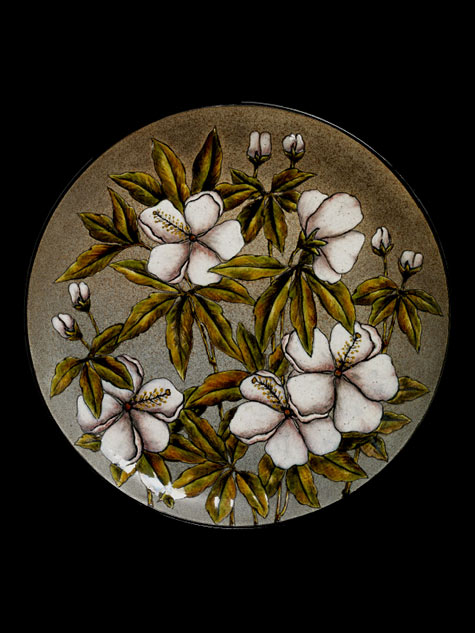
Linthorpe plate C.Dresser V & A museumLinthorpe  Plate – C.Dresser design

Gifted to V & A Museum by Miss Amy Harrison

Christopher Dresser Christopher Dresser

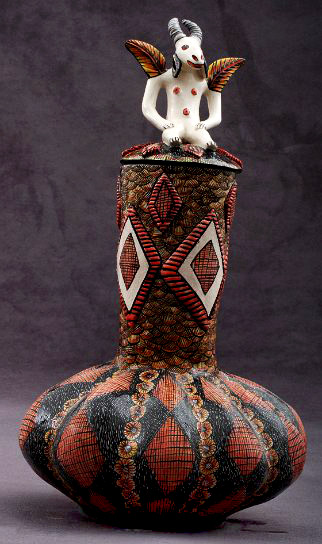
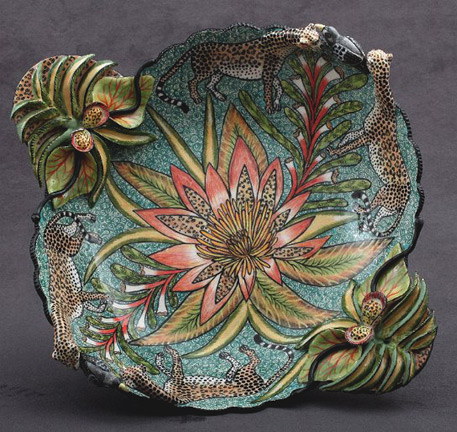
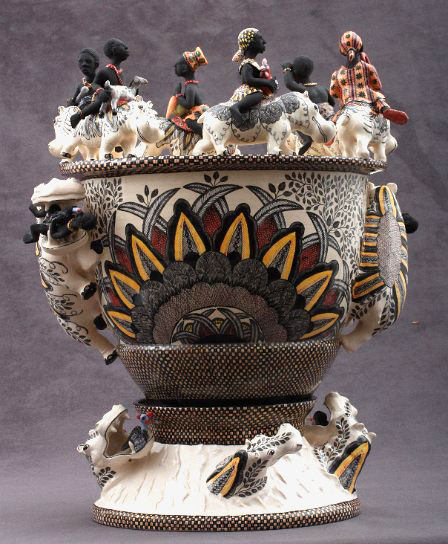
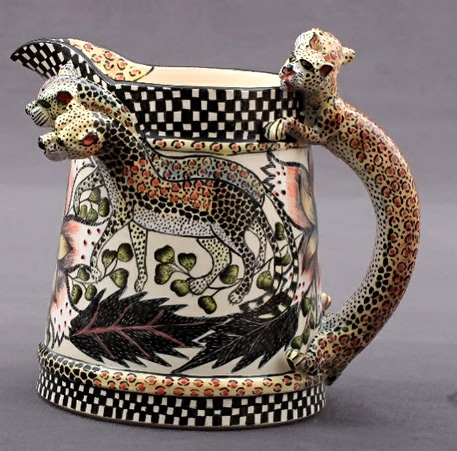
Ardmore African Ceramic Artists

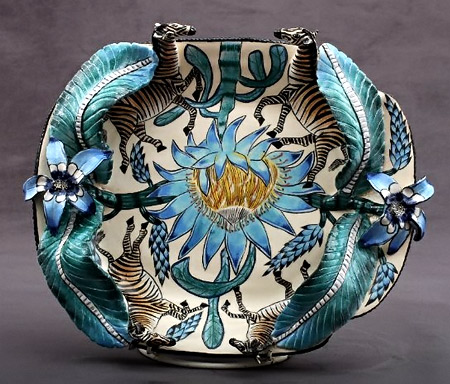
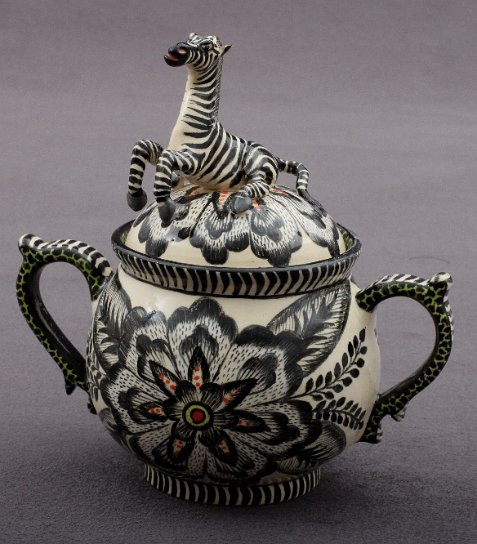
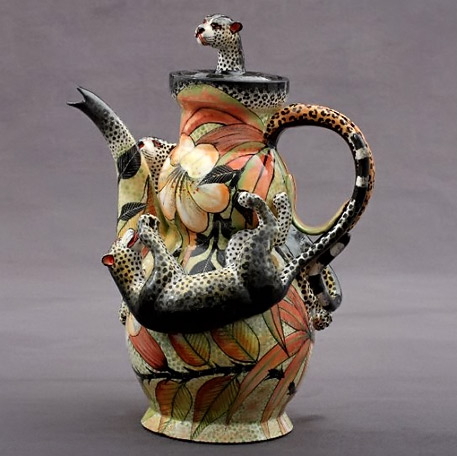
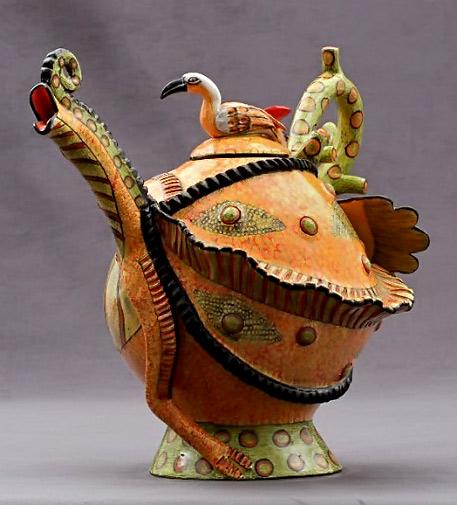
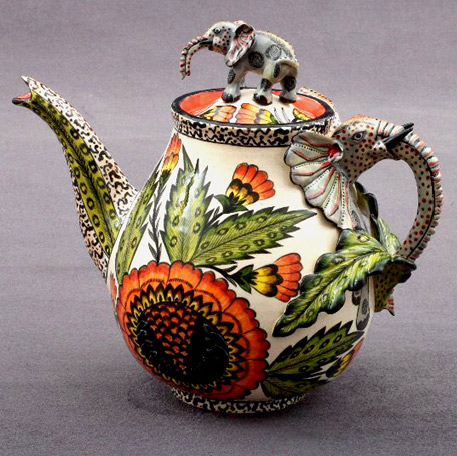
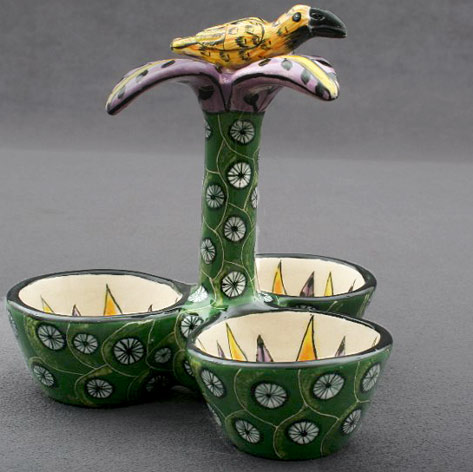
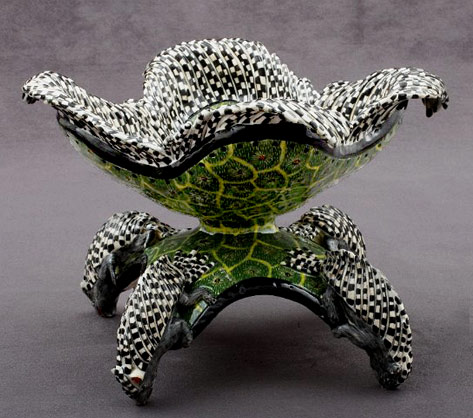
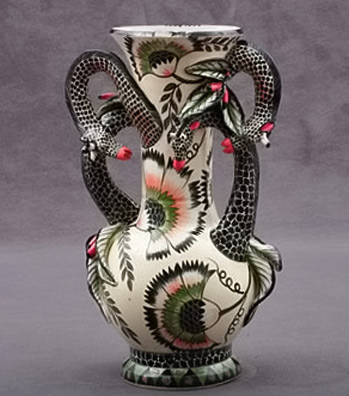
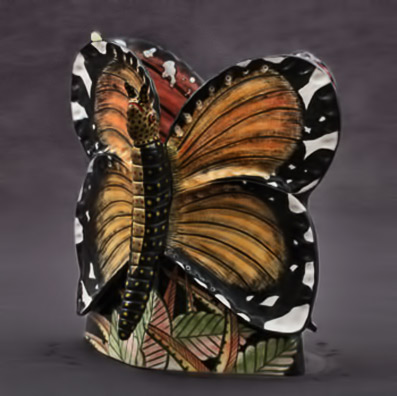
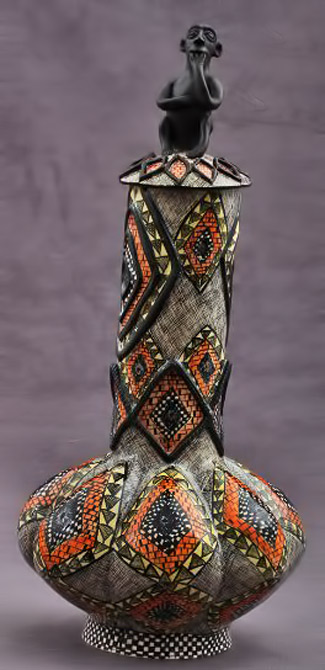
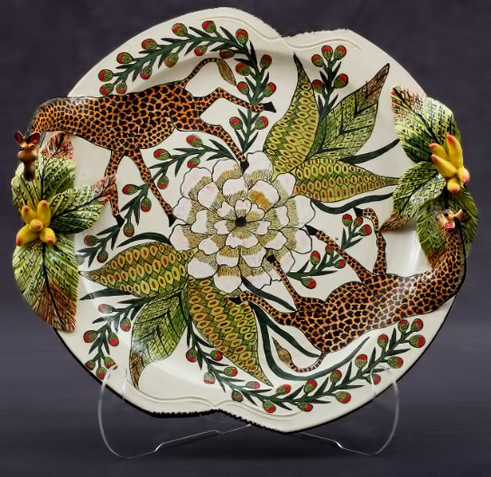
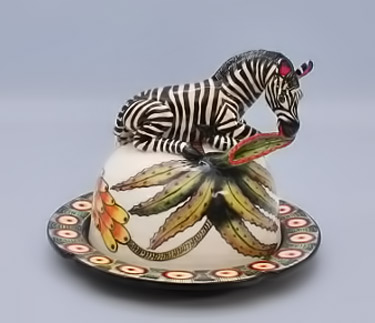
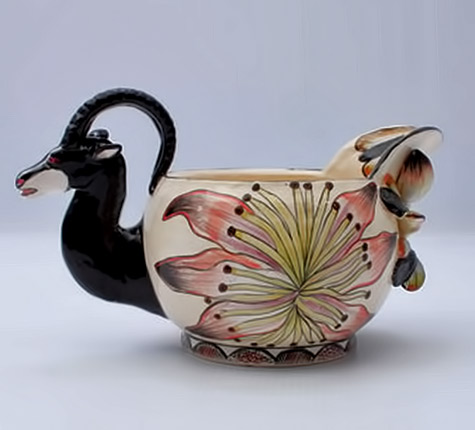
Ardmore Platter  Ardmore Tea Pot

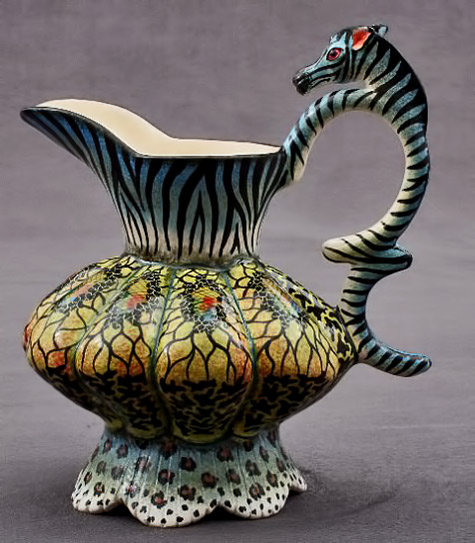
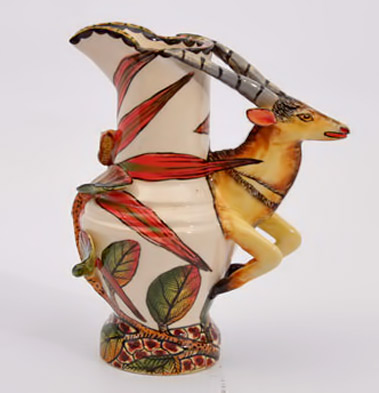
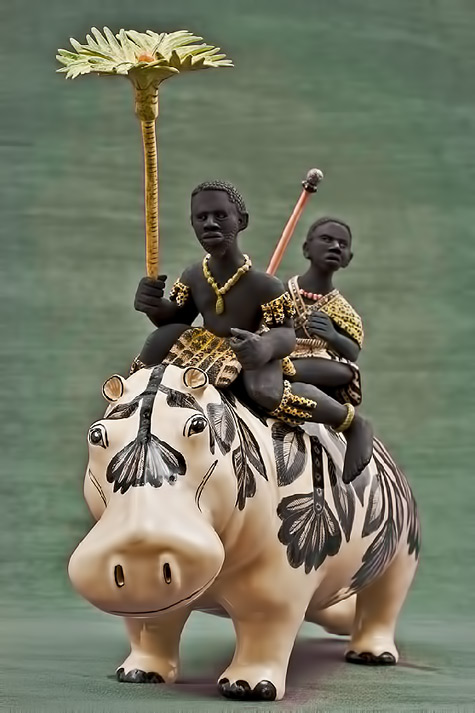
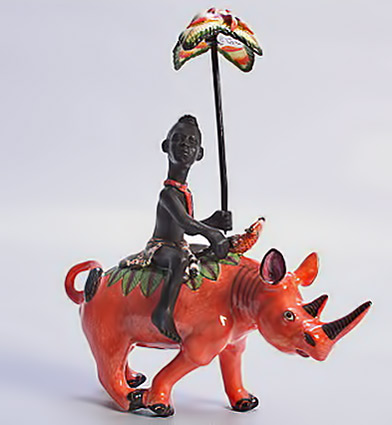
A beautifully  intrinsic  balance of rich colours characterize the ceramic pottery of Ardmore.


The vibrant ceramics of Ardmore, ranging from functional domestic ware to sculptural art in the highly decorative African tradition, offer a fine insight into the subtle influences of rural potters at work in the Champagne Valley of KwaZulu Natal. These artists combine the elements of their tribal tradition with the unique  perspective of a new world. Although the nerve centre of Ardmore has moved to Lavendula in the Natal Midlands, the majority of the artists continue to work on the Ardmore farm near their family homes in the Champagne Valley.

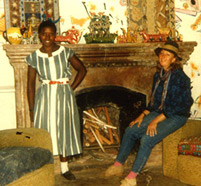
The History Of Ardmore  :    The story of Ardmore began in 1985 when Fèe Halsted lived on the farm Ardmore, in the Champagne Valley under the shadow of the Drakensberg Mountains. Her passions for ceramic art had been honed during her five years at the University of Natal when she had studied fine art and then completed a two year advanced diploma in ceramics.

It was on the Ardmore farm – by ingenuity, by thrift and by chance – that Fèe developed the style that has made Ardmore ceramics famous. “I used to make tiles,” she remembers, “when one cracked, I’d stick a rabbit or bird on the top to hide it.” Then Fèe decided she needed an assistant. This was when luck played it’s part. Janet Ntshalintshali who worked in the house brought her 18 year old daughter, Bonnie, to meet Fèe.

Bonnie who had polio as a child could hardly walk, but showed a natural aptitude for ceramic art. Her ability with colour, design and texture and Ardmore Ceramic Artistsher diligence was everything Fèe could have desired in a student. Within five years, in 1990 Fèe and Bonnie had jointly won the Standard Bank Young Artist Award and their work was being shown in galleries internationally.

When Ardmore first opened the doors of its ceramic studio, the ceramics were produced mainly by women. Gradually, however, their male partners realized that they, too, could work with clay under the scenic backdropof the Champagne and Cathkin mountain peaks of the Drakensberg range located in KwaZulu-Natal, South Africa. These men have transformed Ardmore’s conservative functional earthenware into a more sculptural and courageous art form.

Ardmore Sth Africa

Their patience and extraordinary ability to pay attention to detail gives rise to artwork of tremendous charm and beauty. The creative talent of the artists, their learned skills and their desire to succeed, have resulted in their earning a special status amongst their friends and families and becoming known as the `Isigiwili’, which describes their abundant good fortune.

The women, in turn, have responded to the new creative energy that has flowed into Ardmore and, of their own accord, have modified their style of painting. Their fine feathering, scaling and bead- and basket-like patterns now enhance the form. Ardmore has evolved into a true unique sculptural art.


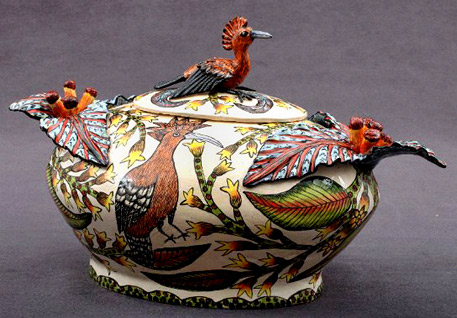
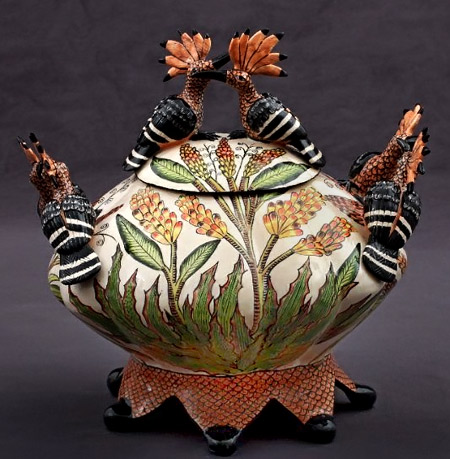
Hoopoe Tureen

Hoopoe Tureen –  Sculptor; Somandla Ntshalintshali, Painter; Goodness Mpinga

Chamelion Tea PotChamelion Tea pot –  Sculptor; Somandla Ntshalintshali Painter; Winnie Nene

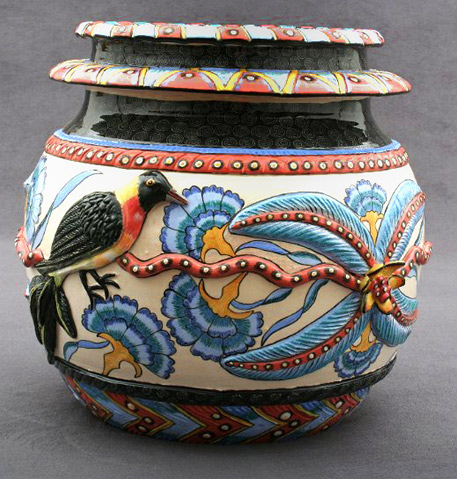
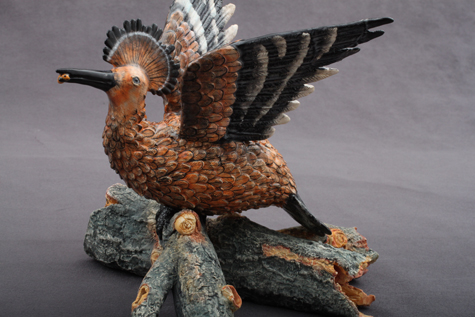
Bird Vase Ardmore

Bird Vase – Sculptor; Lovemore/ Sondelani Ntshalintshali.  Painter; Winnie Nene

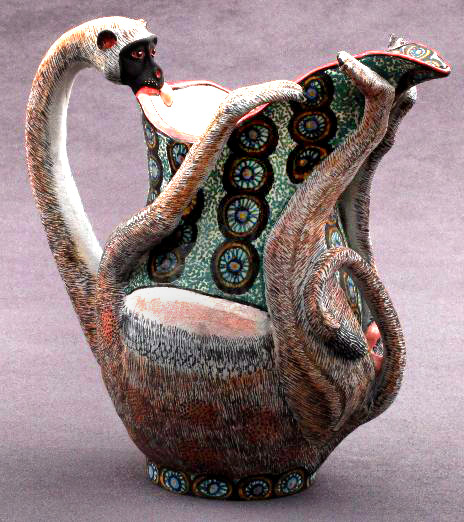
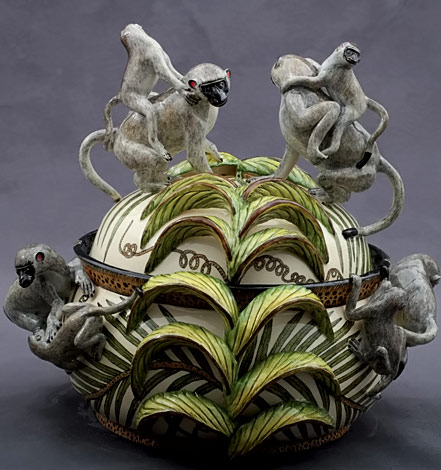
Monkey JugMonkey Jug – Sculptor- Sabelo/ Sfiso Mvelase Painter; Goodness Mpinga

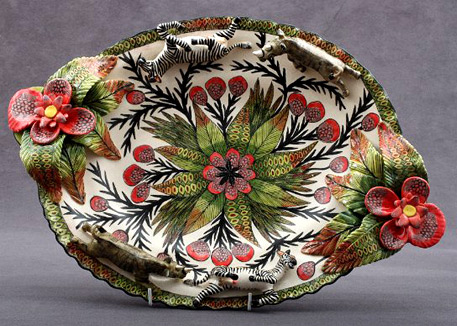
Zebra Rhino Platter Zebra Rhino Platter – Sculptor; Alex Sibanda. Painter; Octavia Buthelezi

Goat Basketing VesselGoat Basketing – Sculptor; Octavia Mazibuko Painter; Goodness Mpinga

Leopard Bird BowlLeopard Bird Bowl – Sculptor; Somandla Ntshalintshali Painter; Rosemary Mazibuko

Hippo Vase Ardmore PotteryHippo Vase Sculptor; Lovemore/ Alex Sibanda Painter; Jabu Nene

◊◊◊

In the beginning  at Ardmore no traditional techniques were used. Their work broke from the ceramic conventions of the time, fired terracotta clay was painted with plaka paints, boot polish and oven blackeners. Glues and putty were also used. Later American Amaco paints and transparent glazes brought an exuberant use of colour and the intricacy of painting style to the ceramics they were making.

◊◊◊

Leopard JugLeopard Jug – Sculptor; Lovemore/ Sondelani Ntshalintshali Painter; Milo Dlamini

Elephant Tea PotElephant Tea Pot – Sculptor; Lovemore/ Sondelani Ntshalintshali Painter; Nondumiso Mfuphi 
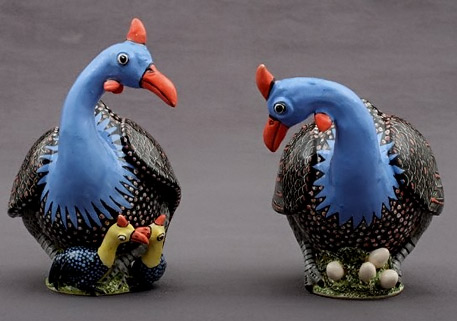
Guinea Fowl Slat and Pepper ShakersGuineafowl Salt & Pepper Shakers -Sculptor; Betty Ndaba Painter; Zinhle Nene

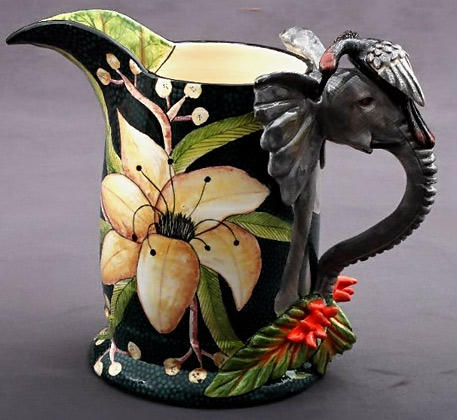
Elephant Jug African PotteryElephant Jug – Sculptor; Sabelo/ Sondy Ntshalintshali Painter; Senzo Duma

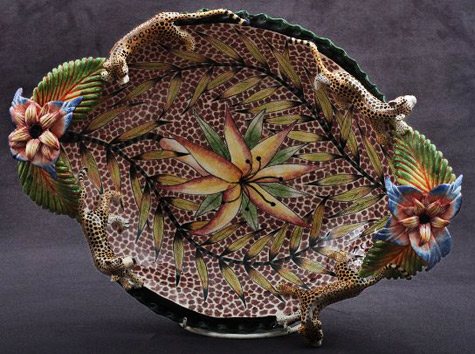
Ardmore Platter

Cheetah Platter  - Sculptor; Thabo Mbhele Painter; Senzo Duma

Hoopoe Tureen Ardmore CeramicHoopoe Tureen – Sculptor; Octavia Mazibuko Painter; Rosemary Mzibuko

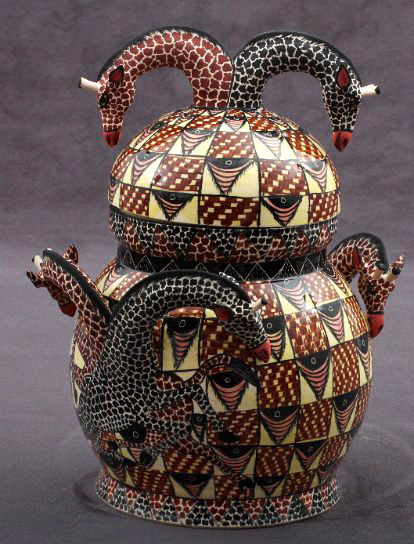
Giraffe TureenGiraffe Tureen – Sculptor; Sabelo Khoza Painter; Sharon Tlou

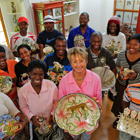
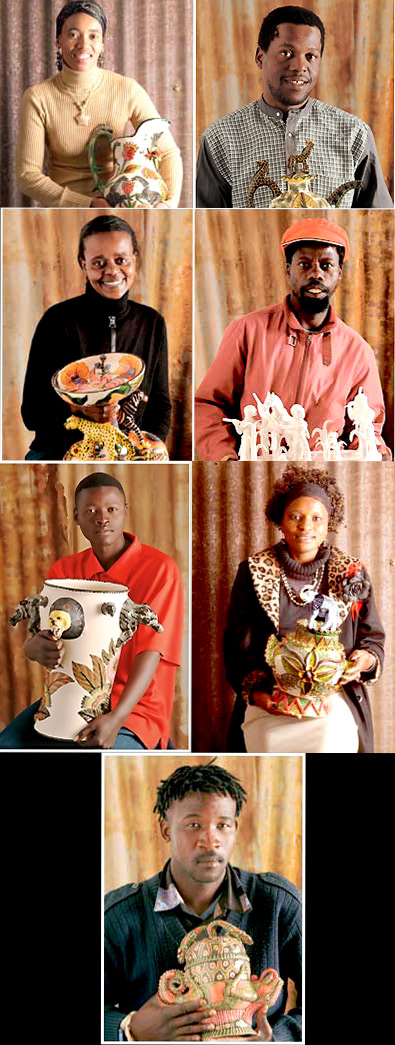
Some of the artists:

Ardmore Ceramic bird

 Ardmore is now heading to Australia! A passionate Ardmore enthusiast, Kelly Foster, has arranged an exhibition at the new Peter Pinson Gallery in Sydney, opening on 14 December – and being opened by Ms Koleka Mqulwana, the South African High Commissioner.

Ardmore Bowls

Bird Egg Cup Sculptor; Lebohang Molefe Painter; Winnie Nene

Porcupine Sweet dish –  Sculptor: Victor Shabalala Painter: Zinhle Nene

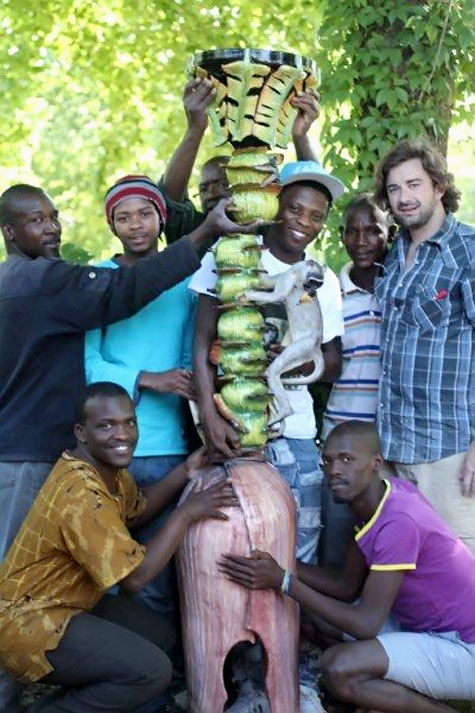
Some of the Ardmore artists:

Ardmore Artists

More Ardmore Ceramics

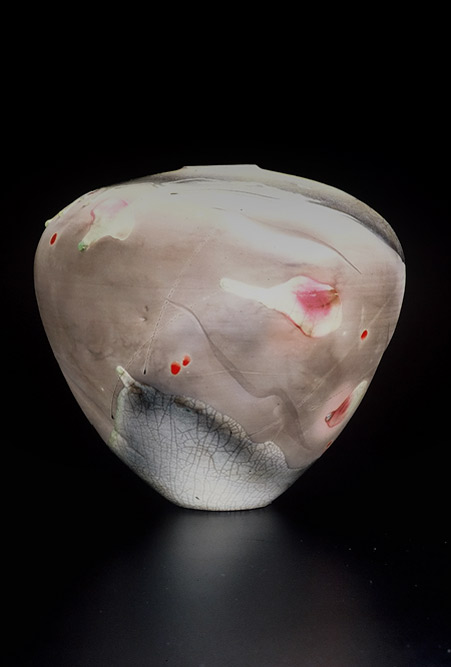
Contemporary Raku: David Roberts

 In his personal exploration of this traditional pottery technique, 45 yo David Roberts has transformed it into a vibrant and contemporary art form. As a distinguished English potter, he has developed an international reputation as a leading practitioner in the art of Raku ceramics.  Roberts is acknowledged as responsible for the introduction and promotion of modern, large scale Raku in Europe. He has also been instrumental in its re-introduction to the United States of America, where his example has played a key role in the foundation of the ‘Naked Raku’ movement.


From David’s Artist Insight  :

” My ceramics are concerned with making the hollow vessel form which acts as a vehicle to bring to expression my ideas and feelings as an artist and human being.
Although I enjoy and admire the work of many potters making functional wares, I am not concerned, in my own work, with usefulness. I am, however, very committed to making vessels as they give focus, direction and context to my ceramics.”

“There is also a fascination with the potential for a simple pot form to hold, carry and imply layers of meanings and references. The formal language of my work reflects the influence of hand built ceramics from different periods and cultures, for example storage jars of West Africa or ritual vessels from Pre-Columbian America.”

‘ Landscape, art and nature, is the world that my ceramics refers to and are influenced by.  The natural world is reflected on a micro and macro level.  In some of my recent work, often in the same piece, I seek equivalents which resonate and echo with the eroded, geological quality of water worn pebbles and rocks together with the contours and traverses of dry stone walls cutting across the Pennine hills above my studio.’

“Since the mid 1970s I have intentionally focused on making large, coil built and Raku fired vessels. I love this way of making as it gives me rounded, volumetric forms which serve as a wonderful three dimensional canvas upon which surface incident derived from the Raku firing can play. The sense of volume and presence that a piece emits when worked over along time period is important to me.  To intensify this tactile and timeworn quality, pieces are often ground and polished after firing.”

“ Landscape and nature gives direction and orientation to my work.  The linear patterns on the vessel’s surface can be simultaneously a reference to rock strata and an abstract means of exploring and articulating the complex interweaving of parabolic curves that make up the form of a coil built vessel.  There is an equivalence between the way that a path or trail moves across the local hills and a tangential line exploring and defining the form of a pot. In doing this I am trying to imbue my work with the same sense of presence and spirituality I get from walking in my local hills.  Similarly smoke lines can evoke botanical structure and growth pattern.”
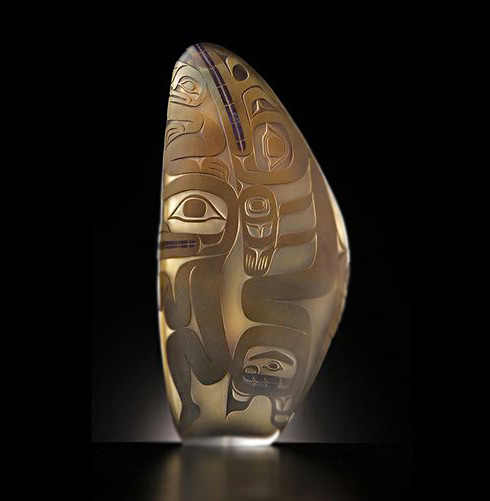
“I use the Raku process as it gives me a consistent and controllable tool in the orchestration of the strength, quality and pattern of carbonisation. The surfaces are not merely covering the form but penetrate deep into the wall of clay resulting in a fusion of form and surface.
At present I am not concerned with colour but with the way richness of tonal variation enhances and defines form. These surfaces are derived from two phenomena; the control of crackle patterns and spotting; resulting from the chemical and physical changes to materials that occur during the rapid firing and cooling of the Raku process, and the linear markings resulting from my application of layers of slip and glaze. These marks both refer inwards to the vessel as a record of the energy of the process to which it has been subjected and outwards as a sign or indicator towards the landscape.’


Notes on David’s technique :


All the work is coil built and Raku fired. Prior to firing, some surfaces are burnished using various levigated slips. Biscuit firing is between 1000C & 1100C. The Raku firing is between 850C & 950C and is completed by a prolonged smoking and cooling process. Finally the pots are cleaned and where applicable sealed with a natural wax.

Eroded Bowl David Roberts Eroded Bowl

Giant Web Vessel

Tall Vessels With Lines

Black on Black VesselBlack On Black

Tall VEssels With EllipsesTall Vessels With Ellipses

David Roberts Raku Vessel 

David Roberts Ceramics Eroded Vessels

Raku Bowl David Roberts

Large bowl David Roberts

David Roberts Studio UK  David’s 2 year renovation of an old barn which became his living/studio/gallery space .

An extract from Ceramics Monthly:

” Yet he has created a personal and recognizable style, combining somewhat contradictory features – an organic technique (coiling) to achieve classical and symmetrical forms; a firing process, traditionally inimical toward large pots, to produce ware with an exactly finished glaze. Art school teachers, certainly those of a less adventurous age, would have told him, had he been their student, not to do it because it would not work. But he has done it, and it does. ”

Tony Birks


Vessel with meandering lines


David Roberts  also conducts Masterclasses……..more info…http://www.davidroberts-ceramics.com


————————————————————————————————————————————


Ceramic Clocks

  ILEA ceramics


Demand for clocks and wrist-watches have generally changed due to the use of cell phones and computers to keep track of time. There was a time when the decorative clock was the focus point in the house. As a decorative piece, the display of mantle/wall clocks probably peaked around the period between the two Wars. Indeed up to the middle of the 19th century, a clock was an expensive object because its clockwork was hand made.Their possession was thus reserved for the elite. In the Twenties a significant industry of the faience clock was developed in Belgium and North of France. ( Faience is a glazed non-clay ceramic material that is composed mainly of crushed quartz or sand, with small amounts of lime and either natron or plant ash. This body is coated with a soda-lime-silica glaze. )

Rare Antique French Faience Majolica ClockRare antique French faience Majolica clock


These clocks became the feature display in the home and took pride of place on the mantelpiece. They were quite often accompanied with two sidepieces, vases or cups. Alarm-clocks started to be produced industrially around 1850; but it was only at the beginning of the twentieth century that clockworks, manufactured in the Black Forest and France, became really cheap. Ceramic (faience) was then the inexpensive “plastic” material in the ceramic producing areas and it was chosen to dress these clockworks.  Hence clocks became visually appealing and affordable to everybody.  The clock shapes of that period  sometimes recalled that of middle-class bronze or marble clocks; some beared animals or peoples sculptures; others referred to the Art-Deco architecture or to Greek temples. Their decorations were also infinitely varied, often very colored, sometimes extravagant. Some imitated marble or stone, others refered to modern decorative styles, to Chinese or Dutch porcelains, to traditional tableware or to avant-garde modernistic painting.

France was very instrumental in popularizing the Art Deco style of that era in the design of the mantel clocks. In France, Belgium and Czechoslovakia there were several ceramic factories that specialized in the production of these mantel clocks. After the WW2  the popularity of the ceramic mantel clock declined due to its labor intensive production costs and the mass production of the wrist watch.


Clock with ceramic face


Aqua Blue Burst Diamond Desk Clock with fabulous ceramic clock face by Marc’s Studio

Handbuilt ceramic clock by Lisa Pritchard Ceramics. The work is predominantly slab built with molded additions.

Ceramic face clock with Arabic script

This 13-inch square ceramic face clock is an excellent example of the ‘cuerda seca’ tradition. This tradition was introduced to Spain by the Moors at a time when all three major Western religious groups inhabited Spain peacefully. The Arabic character on this clock reflects the Muslim part of this tradition. Each piece is hand-decorated by Spanish artisans using the same techniques as have been used since the 15th century.

Wittenberg ceramic clock

Wittenberg ceramic clocks

wittenberg ceramic clock

Ceramic antique clock

Elegant ceramic antique clock in the rococo style.

This little clock was made by the CJCC clock company of Columbus Ohio.

It is made of ceramic and is beautifully painted and enameled in soft blues and gilt on a slightly off white body.

Blue crackle clock

Small blue handbuilt ceramic clock by Sarah McCormack. Multi fired to acheive crackle effect with addition of gold lustre on arms .

Art Deco ceramic clockHandmade ceramic wall clock in an Art Deco style. Designed and made by Malcolm and Russell

Akerman of Echo of Deco.

Art Deco Ceramic clock

Echo of Deco ” Landspeed “

Ceramic clocks art deco

A collection of ceramic fasience Art Deco clocks from the Clockarium Museum in Belgium.

Whimsical Slate Blue Clock  by Eileen Young

 Hand-made ceramic clock using hand-cut porcelain tiles.

Art Deco Faience Clock

Fasience Art Deco clock from the Clockarium

 English Coalbrookdale porcelain clock

 English Coalbrookdale porcelain clock. Circa 1830

Gavin Douglas Antiques

Ceramic clock styled to look like metal.

Pillow shaped ceramic clock

Pillow shaped ceramic clock by Creativewithclay


 Ceramic Clock Hand built from earthenware clay in 3 parts middle section and lid lift away from base.

The piece was fired 3 times finishing with a lustre firing of bright gold.

Vintage Cartier 1930 Art Deco Clock

Vintage Cartier 1930 Art Deco Clock

Art Deco Clock

Amber Custom Scientist by Echo of Deco

French Clock 1893

( ARTIC )

Sirenes clock RENE-LALIQUE

Rene Lalique Sirenes Clock – 1928

V & A Museum Ceramic galleries refurbish

V and A refurbish

The Victoria and Albert Museum’s collections span two thousand years of art in virtually every medium, from many parts of the world, and visitors to the museum encounter a treasure house of amazing and beautiful objects.

The refurbishment of the Victoria and Albert Museum’s ceramic galleries has created an important national and international centre for the enjoyment, understanding and study of ceramics and a collection that is unrivalled anywhere in the world.

Six  years ago, over concern for the security of the collection, the V&A’s Ceramics galleries closed to the public. Purpose built in 1909 for the display of the Museum’s ceramics collection, the galleries had changed very little over the years and the old cases and displays no longer met modern museum standards or audience expectations.

In 2005 the V&A began the task of funding, redesigning and redisplaying the galleries so that once more the world’s most comprehensive ceramics collection could be secured for the study and enjoyment of future generations. This was completed in 2011.

V & A Ceramic gallery in the 50″s


YouTube Preview Image


A selection of ceramic pieces in the Victoria and Albert Museum:


Fritware with underglaze

Fritware bottle painted in underglaze decoration in blue and black. Iran 1500-1600

A   Maiolica ( tin glazed earthenware ) pilgrim bottle made in Urbino, Italy. 1560 – 1580

Gallery location: British Galleries room122g case 2

Porcelain snuff bottles painted in enamel colours, China 1821-1850. Snuff was powdered tobacco

mixed with aromatic herbs and spices.

Gallery location: Ceramics Study Galleries, Asia & Europe, room 137, case 14, shelf 8

Staffordshire  teapot, solid agate ware with lead glaze 1740 – 1750.

British Galleries room 53a case 1

Minton and Co. Maiolica dish made at Stoke-on- Trent, 1866

Gallery location: British Galleries room 125b case 2

Chinese Handan stoneware decorated in black under a turquoise glaze, 1300-1400. this design was influenced by Syrian ceramics.

This elegant vase appealed to George Salting (1835-1909), a passionate collector who bequeathed to the Museum a large number of Chinese ceramics. When Salting bought this piece it was already more than 400 years old. The Chinese had always treasured ancient ceramics, but it was only after the opening up of China to the West after 1840 that antique items became available to other collectors. The appearance of these hitherto unknown objects on the British art market inspired artists to create new forms and patterns.

British room125c, case1

Staffordshire earthenware bowl and bottle with moulded decoration and stained lead glaze.1760-1765

De Morgan Pottery

De Morgan earthernware vase painted in lustre. 1888-1898.

De Morgan’s passion was for the arts of the Middle and Far East.  He drew virtually all his inspiration from the richly-coloured, lustred and ornamented wares of Persia (Iran), from the ‘Isnik’ wares of 16th century Turkey and from Renaissance Italy.

De Morgan gave a very clear account of his method of lustre firing in a lecture given in 1892.  This, simplified, describes mixing metallic oxides, such as copper or silver, with white clay, to which was added gum arabic to make handling it easier. This was painted on and the ware was packed closely in the kiln, fired at a low heat.  At the critical moment, dry material such as sawdust was introduced into the kiln and, once fired up, the kiln is shut down closing off all oxygen.  This smoke-filled environment is known as a ‘reducing atmosphere’.  The effect is to leave an iridescent metallic deposit on the surface, which must be cleaned and polished once the ware has cooled.

Christopher Dresser designed ceramic vaseWilliam Ault Pottery glazed eathenware vase designed by Christopher Dresser. 1892 – 1896

British Galleries room125e, case 2

See more Christopher Dresser here

Shropshire eathernware Vase V and A museum

Shropshire earthenware vase 1889 – 1891 Designed by Walter Crane

Elizabeth Fritsch, ‘Optical Pot’, stoneware, height 311mm, width 232mm, 1980. Museum no. C.13-1981

Royal Doulton Vase 1879

Royal Doulton Earthenware Vase 1879 ( Lambeth ).

Tin-glazed earthenware, painted

Tin-glazed earthenware, painted. Bristol  1720 – 1730

Ewer 17th century Iran

Ewer, 17th Century Iran

Victoria and Albert Museum


Australian Potter Jeff Mincham


” I’ve always thought of myself as living in a landscape, perhaps its because I’ve never lived in a city or even a town for longer than a few months. The events of the landscape draw me towards it. My works  explore my engagement with its moods, its changes and dramas. They speak of harsh dry windswept lands, of the shimmering distance beneath brooding skies. A passing moment of mystery and wonderment captured by the eye and embedded in memory.” …   Jeff Mincham, 2007
Jeff Mincham Ceramic Bowl
The floodplain – high-walled, multiglazed, multifired ceramic bowl.
Craft Australia in conjunction with Object: Australian Centre for Craft and Design has the award : Living Treasures: Masters of Australian Craft which celebrates the achievements of Australia’s iconic and influential crafts practitioners and is designed to promote the work of Australian artists whose exemplary craft skills that have been recognized by their peers.
The fifth recipient of this  title, Australian ceramicist Jeff Mincham is a craftsperson of the highest order. Since he first exhibited his work in 1976 at Adelaide’s famous Jam Factory, Mincham has continued on with his dedicated practice for over three decades, working, exhibiting and experimenting with techniques and methodologies.

His practice, largely influenced by the ancient Japanese technique Raku which he has both taught and followed, depends on temperature and fire. Having worked with this method for near on two decades, Mincham, impressively, moved to another way of working in the mid 1990s, focussing on drawing from the local scenery.

Mincham’s rigorous early training with both Milton Moon at the South Australian School of Art and Les Blakebrough at the Tasmanian School of Art  is evident in his disciplined approach to technique and form. But the maverick spirit which drew him to the highly unpredictable field of raku is alive and well.

Jeff Mincham Ceramic Vase

Summer grasses I – thrown, multiglazed ceramic form with brushwork.

jeff mincham raku bowl

Edge of the tides – hand built, multifired ceramic tea bowl.

Jeff Mincham is one of Australia’s most prominent and long established ceramic artists and for thirty years his practice has been influenced by the remarkable landscape setting of his home in the Adelaide Hills.  His beautifully resolved vessels contain a visible dialogue between the artist and the environment in which he lives and works, a narrative that is particularly resonant within the ceramic medium which is of the earth but shaped by human hands.  The highly tactile surfaces of these vessels are the result of a unique patination process that Jeff refers to as ‘firing and weathering at the same time’.  “The colours, moods, textures and events comprise a universe of constant change which retains a seamless, constant identity and provides an inexhaustible source for my forms and their surface treatments.  The works are often fired many times to achieve the depth of surface and unique character that they finally attain and many do not survive the journey.  However, I have survived a long journey myself to arrive at a point of strong resolution in my work and I conclude that it is the constant struggle that produces the best results.”
He has held over 40 solo shows across Australia, and exhibited in the USA, Asia and Europe.  His ceramics have been widely collected and are represented in the National Gallery of Australia and most major state and regional galleries.  Jeff’s work is also held in many overseas collections such as the Aberystwyth Arts Centre (Wales), Johnson Collection (USA), Silber Collection (USA), National Gallery of Malaysia, State of Hawaii Public Collection and Taipei Fine Arts Museum (Taiwan).


Jeff Minchem Vase

Day into night – multiglazed and multifired elliptical vessel.

From an interview with Karen Finch ( Craft Australia ):  Growing up in a rural environment, he says, conditioned him to deal with the landscape and it remains the most common basis for his work. The impact of Japanese style, techniques and philosophies has influenced the way he looks at the landscape and reinterprets it in clay. He is preoccupied with the mutability of his surroundings, monitoring natural events, how objects grow, die and rot – the cycles and processes of the natural world. The combination of a solid form, most often a vessel form, and a figured surface becomes a metaphor for the idea of shifting changes over an underlying structure. Decorative motifs in his work have gradually become more abstract as he searches for the means to communicate the essence of the landscape rather than use the surface of the form merely as a three dimensional canvas. Textures, colours and varied surfaces vie with each other to create a sense of the inherent conflict between order and disorder within the landscape, conveying messages of emotional communication to the viewer.
Jeff Mincham Raku vessel

Lichen – thrown, hand built, multifired ceramic bowl.

Jeff Mincham Ceramic Vase

First rains – coil built, elliptical ceramic form with carved image.

Ceramic Vase Jeff Mincham

Hill views – multiglazed and multifired elliptical vessel.

Windswept hillside – elliptical carved vessel.

Home of the curfew. 2009

Estuary – multiglazed oval vessel.

Reconstructed landscape I – multiglazed rectangular faceted vessel.
Gustavo Perez Mexican ceramicist.

 ” I can’t think of a better way to define my work than quoting what Franz Schubert once said: “I just finish one piece and begin the next”. ……Gustavo Perez
Recently, Gustavo completed an excellent interview…..

Can you tell us something about yourself? Where do you live and work?

I am Mexican, I work mostly at my studio in Zoncuantla in the state of Veracruz, in Mexico. But I also work, a few months every year, in the atelier of my partner Brigitte Pénicaud in France, at Les Places, close to Argenton sur Creuse.

Where did you study ceramics or another art discipline?

I studied for two years at Escuela de Diseño y Artesanías in Mexico City (1971-73). Then, after some ten years of work, I had a grant to study for two years in the Sint Joost Akademie voor Beeldende Kunst, in Breda, in the Netherlands.


Which reasons do you have for choosing clay as means to express yourself or realise your ideas, concepts or forms ?

Many times I have said I did not really choose clay; I have the feeling that in fact clay chose me… for several years I had been looking for something to devote my life to, it was a difficult time. But the moment I smelled (!) clay in an atelier, and I saw a throwing wheel, I knew that was the activity I had been looking for.

What was the starting point where from your current work has grown?

The throwing wheel, it all starts there.

Which message you hope to convey to your spectators?
I hope it can be understood that if one wants to be creative with clay, craftmanship (le métier), is essential. I am convinced of the necessity to give everything one can give, and for many years, before a personal way, a personal language can be discovered. For me it took some 22 years before I could feel there was something that I could call really mine.
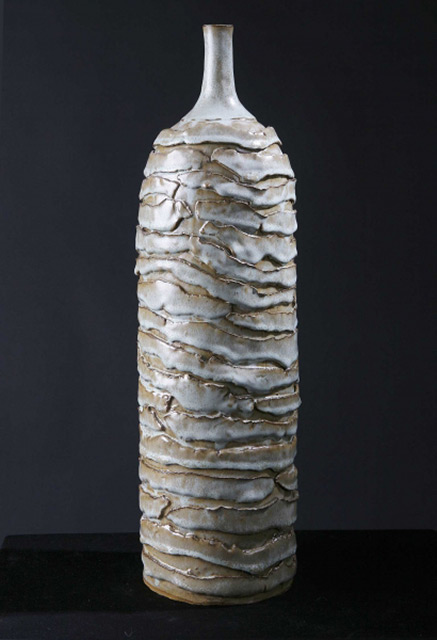
Creativity is a deep mystery, something like source that does not flow until a certain personal “position” (an attitude, a confidence, an openness) is found. And this sort of secret cannot be transmitted, it has to be a personal discovery after a lot of work… so, the only possible idea to transmit would be this: you need to work and work and work…


Which importance has design in your work and what is the relation between design and clay?

It is important. Because while in fact what I do in my research is mostly playing with the possibilities that appear along the development of series of pieces, I am aware that I always do it in a certain quite systematic way: going from one piece to the next as in a game, trying just every idea that comes to my mind.
And about the relation between design and clay, I can say that I cannot see at all a border separating art and design. Or at least I do not care about it.


What is the meaning of colour for you and your work and what is the relation between colour and clay?

Colour seems not to be as essential for me as form and surface treatment. For some years, while my work concentrated basically on the graphic aspects of what can be done on a pot’s surface, I had the feeling that a good black glaze was all I needed to develop my ideas. However, nowadays I am convinced there has to be a certain presence of colour in my work, because I definitely feel some few colours that belong to it: subdued, natural… colours that are close to earth, to the colour of clay itself.

What was for you the most important moment in your ceramic career?

I guess it was the moment when I discovered, by accident, the effect produced on the wall of a thrown piece by making an incision open as in a wound. What Garth Clark called “the gentle cuts”. This discovery produced without a doubt the international recognition for my work. And I must say that I felt a profound pleasure in realizing that such a simple effect (because it is indeed a very easy technical resource) had never been used in the thousands of years of ceramics history, ot at least, never had been really developed.


A strange thing is that nowadays there are many young ceramists using this effect on their work (which is alright with me, I never tried to keep it as a secret or a personal “property”), and even some that claim to have discovered the effect themselves… which is not for me as easy to take. (Of course you are aware, because it happened in your own Keramiek Atelier page, of a discussion around such a situation)

Which artist is or has been an inspiration for you?

Just too many. But to mention one, Brancusi.
Or to mention two: Schubert
Or three: Rembrandt… Picasso, Francis Bacon, Paul Klee, etc…

Which ceramic works and ceramist do you admire in your own country and internationally?

In Mexico I respect the work of Jorge Wilmot, from the generation before mine.
And internationally…. many:
First: Hans Coper, a deep influence.
Also, from the past, Kanjiro Kawai.
From our times, there are really many whose work I follow with interest. I cannot mention them all (I will forget many important ones) but in a fast recollection I would say: Gordon Baldwin, Claude Champy, Claudi Casanovas, Lawson Oyekan, Peter Voulkos, Bernard de Jonghe, Johan van Loon, Enrique Mestre, Yasuo Hayashi, Eva Hild, Alison Britton, Tatsusuke Kuriki, etc.

Can you remember the best ceramic exhibition you ever saw?

Maybe Claudi Casanovas at Boijmanns Museum in Rotterdam, 1982 (?)

Do you have a gallery where we can see your work or where you exhibit frequently?

The Frank Lloyd Gallery in the USA

http://franklloyd.com/

Loes en Reinier, Deventer, Nederland

http://loes-reinier.com/

Puls in Brussels

http://pulsceramics.com/

Galerie Capazza, Nançay, France

http://galerie-capazza.com/

Galerie de l’Ancienne Poste, Toucy, France

http://galerie-ancienne-poste.com/

Do you have one or more exhibitions in the near future?

At the Frank Lloyd Gallery.                                   March 19
Puls.                                                                               September

Do you have a website?

It is under construction, almost ready

Thank you very much.

Graag gedaan
Hartelijke groeten,

Gustavo Pérez

Reproduced from :

http://keramiekatelier.wordpress.com/interviews/


Currently on display at the Frank Ll0yd gallery, the exhibition Recapitulando marks, for the artist Gustavo Pérez, a summation of his work.

This will be the seventh solo exhibition of Perez’s work at the gallery. Two large scale examples of his work are included in this show, Triangulo and Tablero. The installation piece Triangulo is composed of dozens of small cylinders, cut at a precise angle and placed face-to-face in opposition. The sculpture forms an equilateral triangle, and though it is based in geometry alludes simultaneously to minimal art and optical illusion. Tablero is a wall relief, composed of 49 small abstract forms. Although the individual pieces are made by straightforward folding and forming of the clay, the resulting image has a primitive presence.
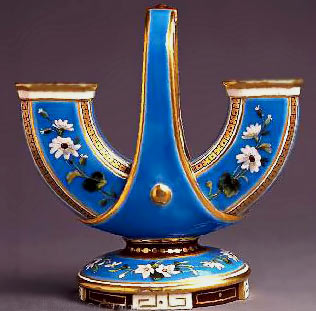
Gustavo Perez Ceramic Vessel Gustavo Perez Vases


D.Michael Coffey..Colorado Ceramic Artist

Shino tea bowlShino teabowl textural finish

Michael Coffey appears to be very mindful of the Eastern philosophies and attitudes regarding art when he his creating  ceramics. This is encapsulated in his article on the process of creating his works for ” my Special Offering to the Tea Community” …..

” The pieces were Created, Bisqued Fired, Glazed and finally given over to the potential calamity of the violent inferno of the Kiln. All these steps come with a certain level of anticipation and forward visioning, even though I’ve spent decades practicing the discipline to not envision a specific result, it’s hard not too.

The Glaze Firing went well, and despite my attempts to suspend a vision of the work inside the kiln, I was viewing finished works in my head. Upon opening the long cooling kiln I was again, as always surprised. I had visions of pieces with a more “graphic” visual and tactile presence. The kiln had other “visions.”

The kiln’s “vision” was to cause a kind of “forced restraint” upon the work in this firing. I liked the works before me, still too hot to touch, I had time to think. I was being reminded of a valuable lesson as well as being reminded of a short book I read over 30 years ago on Aesthetics, “In Praise of Shadows.”

“In Praise of Shadows”, was written by Jun’ichiro Tanizaki and was originally published in 1933 in Japanese and later translated to English in 1977. The essay consists of 16 sections that discuss traditional Japanese aesthetics in contrast with change. Comparisons of light with darkness are used to contrast Western and Asian cultures.

The West, in its striving for progress, is presented as continuously searching for light and clarity, while the subtle and subdued forms of oriental art and literature are seen by Tanizaki to represent an appreciation of shadow and subtlety. In addition to contrasting light and dark, Tanizaki further considers the layered tones of various kinds of shadows and their power to reflect low sheen materials like gold embroidery, patina and cloudy crystals.

The works being offered here require close study to fully appreciate the depth of nuance in the glaze finish. They don’t shout their presence, they are comfortable in the realm of the intimate object. ( see above )

Who is Michael Coffey :


With over 30 years of combined experience in architecture, ceramics and fine art printmaking, Pagosa Springs, Colorado, Professional Artist, D. Michael Coffee, has amassed an extensive body of original functional and sculptural ceramics and hand-pressed “Reductive Ink” monoprints.

Coffee’s Shino, Ash and Tenmoku glazed stoneware of  Chawan, Yunomi, Guinomi and Mizusashi are highly collected by practitioners and enthusiasts worldwide. Coffee’s sculptural and functional ceramics are included in hundreds of prestigious public and private collections throughout the world, and have been shown in numerous solo and invitational exhibitions.
” All works of art that I offer in my shop are handmade solely by myself in my studio located in Pagosa Springs, CO. I work independently without the aid of assistants.  Coffee has been interested in ceramics since high school, where he served as a teaching assistant firing kilns, mixing glazes, and teaching himself to throw on the potter’s wheel. Although driven by an artist’s leanings, he chose to enter school to study Architecture.


In 1994 Coffee would finally return to ceramics, where he started twenty-five years earlier to fully realize true artistic freedom. He was clearly at the place in his artistic journey where he felt the most comfortable and inspired. He was finally able to work from pure instinct and intuition, honed from decades of study in design and aesthetics. He was able to work with materials that were simple, yet offered endless possibilities.

For D. Michael Coffee, limits don’t appear to exist. Every firing provides a unique opportunity to learn, if even from the failures. It is hard to say what feeds Coffee’s own internal flames, other than an overwhelming desire to create.

Michael claims in his artistic statement :- ” Art is my passion and the true backbone of my existence. I have worked extensively in all types of media, including painting, wood, metal, glass, architecture, ceramics and printmaking. I cannot lay claim to any particular style or genre, as I am primarily interested in nonlinear paths of development in the objects I make. Each step of the art making process is part of a personal inner journey. The common thread that stitches my work together is an overriding desire to be surprised by the outcome, as though I wasn’t present during the process.

The art that I create is a product of a concerted effort to exploit my powers of informed intuition for the sheer joy of attempting to reach a “mindless mind” state of awareness. That moment, one nano second before clear cognition again takes over the creative process. For me, the challenge is to let go of predetermined understanding and foresight, and to work on developing my instincts. I strive to create outside of my conscious self, empowered by the strength of my intuition. I tend to select materials that are simple, so as not to become material bound. When I’m successful, the work I create truly represents the sum total of my life experiences and visual histories.
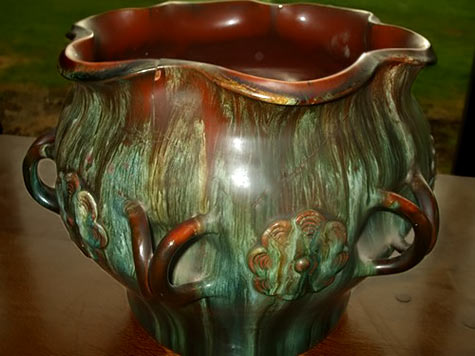
I am also interested in the aesthetic concept of Wabi Sabi, the beauty of things imperfect, impermanent, incomplete, natural and unconventional. I believe that it is impossible to mindfully or intentionally create works that possess these characteristics. By applying my intuition and instincts, I hope to fend off the development of immunities to the fascinations that are right in front me. ”

Michael Coffee is also the  Co-Founder and Creative Director of  SHY RABBIT Contemporary Arts in Pagosa Springs, Colorado, Coffee has been responsible for organizing, curating and installing over 20 fine art exhibitions over the course of the last five years.and has transformed SHY RABBIT into the region’s most important and innovative contemporary arts space. For more information on D. Michael Coffee:  Visit his website here

Shino and Slip Glazed Stoneware Vase Chawan TeabowlSatin Celadon Glazed  CHAWANShino and Copper glazed Yunomi Tea Cup

Yunomi Teacup

MATCHA CHAWAN TeabowlSHINO Glazed MATCHA CHAWAN

Yunomi Cup

Korean Ceramics

Wine_pot_with_gold_lacquer

Celadon Wine Pot

The Three Kingdoms of Korea (57 BC-668 AD), namely Silla, Goguryeo, and Baekie, provided the beginning of Korean ceramic history. Rough domestic wares for the people were produced from numerous kilns. Likewise a number of very sophisticated statues of royal figures, guardians, and horses, equivalent to Chinese Han Dynasty figures, used for domestic and imperial votive shrines, as well as for escorts of the dead in tombs of the nobles and kings, were turned on potter’s wheels, while others were formed using the traditional hammered clay and coil method.

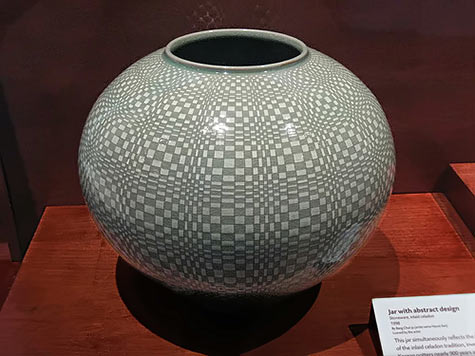
During the nearly five centuries of the Koryô dynasty (918–1392), celadon was the main type of ceramics produced on the Korean peninsula. This exquisite ware was typically covered with clear and highly-vitrified glazes of gray-green color. The color of Koryô celadon owes much to the raw materials—specifically, the presence of iron in the clay and of iron oxide, manganese oxide, and quartz particles in the glaze—as well as to the firing conditions inside the kiln. The combination of beautiful glaze with elegant forms without any surface decoration resulted in exceptional vessels produced during the early part of Koryo celadon production between late 11th Century and early part of 12th Century. After the Koryo potters had perfected their skill of producing perfect celadon glazes, they started to experiment with carved and incised decoration under the sea green glaze.
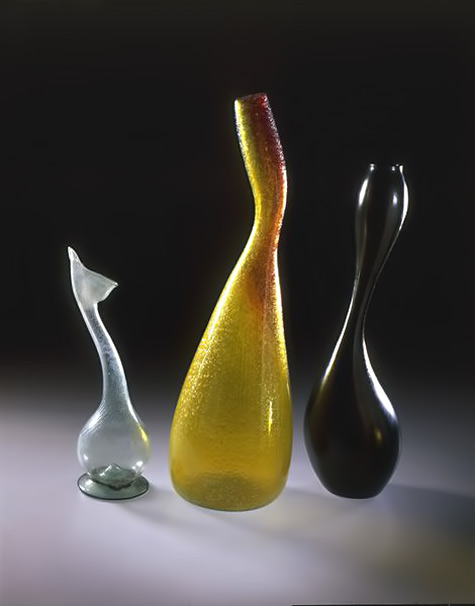
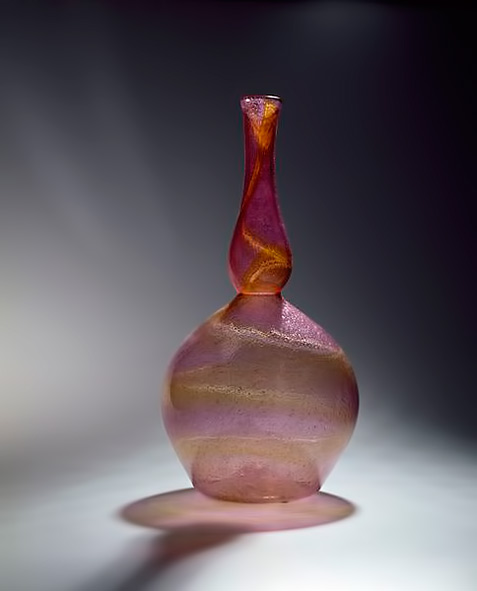
Korean celadon from the Goryeo period is renowned, especially for its pale, jade-colored glaze, which exhibits the potters’ advanced understanding of color composition at that time. Although Goryeo’s early celadon was
influenced by the Chinese, Korean potters developed the borrowed art to a new and unique level.  The Koreans added graceful designs onto the surface of the ceramics by using the remarkable inlaying technique, an entirely Korean invention. It is said that even the Chinese considered Korean celadon the best under heaven and more valuable than gold.
Korean Celedon Vase

Korean white porcelain became popular in the Royal court of   the Choson period. During late 15th Century, the Choson court established a group of kilns called punwon (in today’s Kwangju). Early Punwon kilns in 15th/16th Centur produced white porcelains of elegant shape, impeccable high luster glaze with bluish tint, and thinly potted pure porcelain body for using exclusively in the royal court.  Although plain white-bodied porcelains were favored throughout the Choson period (1392–1910), decorated versions of the same wares were also produced in large quantities. The Chinese blue-and-white wares of the Ming dynasty served as one model for Korean potters, who adopted the technique of underglaze cobalt-blue decoration. Unlike its Chinese counterparts, the Choson potters worked closely with court painters to produce vessels with superb paintings rivaling surviving paintings on paper.  Korean potters of the 16th century started to experiment with underglaze iron pigment on porcelain. During the Joseon Dynasty, (1392–1910) ceramic ware was considered to represent the highest quality of achievement from imperial, city, and provincial kilns, the last of which were export-driven wares. This was the golden age of Korean pottery, with a long period of growth in imperial and provincial kilns, and much work of the highest quality still preserved.
Lee Kang Hyo Ceramic Bowl

Lee Kang Hyo Buncheong Style Bowl


Hidden between the demise of celadon and the rise in popularity of white porcelain ware, Bun-cheong enjoyed about a one hundred year reign as the most common type of pottery, and was used by both the aristocracy and commoners throughout Korea.

The aesthetics and functions of buncheong ceramics reflect social developments of the beginnings of the Joseon dynasty at the end of the fourteenth century. Most were everyday wares used by people at many levels of society. Later buncheong allowed for increased regional expressiveness and creativity.

As versatile as potters anywhere, the buncheong artisans used many techniques to create their art. Stamping was generally used to produce multiple images on an item. Buncheong artisans reinterpreted traditional iconography, often allowing only the essence of the image to emerge. Asian floral designs, peonies, chrysanthemums and lotus were defined in linear motifs. Animals, too, such as the tortoise on an elephant vessel, were also interpreted as a swash of lines. Occasionally, mythical animals change form under the artist’s guidance. For instance, a dragon and fish are joined as a “dragon fish,” the enigmatic emblem of an anonymous artist.

It is noted by art historians that Japanese ceramics became noted the world over after the invasion of the Korean Peninsula by Japan during form 1592 to 1598. This has poignantly been described as The War Of Ceramics because when the Japanese forces left they kidnapped several thousand potters from the Joseon Dynasty to bring home as war trophies. These wonderfully talented artisans became the cornerstone for Japan becoming a producer of fine ceramics. Some of the descendants of these earthenware artisans, including the ” Six families of Imnan  Potters” ( referring to the7 year war ) are still thriving and revered as Japan’s top potters.

Cinerary_urn,_unglazed_stoneware

White_Ceramic-Baekia

Korean Ceramic plate moon and reed design

Iron-black-red-copper-paint-fish-design-Korean-dinner-plate

Korean dinner plate with iron black and  red copper paint fish design

 Pottery Vase Buncheong Gray with Inlaid Lotus and Fish Design

Vase Buncheong Gray with Inlaid Lotus and Fish Design

 Floor Vase Buncheong Gray with Inlaid Arabesque Design

 Bottle Buncheong Pottery with Impressed White Woven Mat DesignThis buncheong pottery flowers bottle features a unique Korean traditional water bottle body decorated with impressed woven mat and Maehwa (Korean plum flower) design. Traditionally,  buncheong ware with an impressed design accompanies one or more inlaid designs.

One of the sagunja (“four noble beings”) motifs loved by Korean artists, maehwa refers to the Korean plum blossom that has long been the herald of spring. Korean artists have been fascinated by maehwa, which blooms at the end of winter, and thus have praised it as a symbol of the noble spirit overcoming all hardships

 Porcelain Tea Bowl with Brown Design in White

 Porcelain Bowl  Antique in Light Brown for Tea Ceremony

Antique Korean Porcelain Bowl in Light Brown for Tea Ceremony


Pottery Storage Jar with Iron-Painted Brown Peony Flower Design on White

This exquisite buncheong pottery storage jar, the design on which appears like a traditional Korean ink painting,

exhibits a round body swept with a pigment containing iron, giving the effect of paint brushed on paper. The contrast of colors between the brown peony flower and the white background creates a delightful scene to look at. The fully open peony blossom is traditionally a symbol of wealth and nobility.

Flask-Shaped Bottle, Joseon dynasty (1392–1910), Flask-Shaped Bottle, Joseon dynasty (1392–1910), late 15th century
Korea
Stoneware with sgraffito decoration of flowers under buncheong glaze. ( Met Museum )

Contemporary Korean Ceramic Contemporary Korean Ceramic -Guac Roh Hoon  ( V & A Museum )

 Korean National Treasure No. 787 uses inlay, stamping and iron painting to create the design of fish and lotuses. ( Leeum, Samsung Museum of Art, Seoul. )

Tall Korean VaseKorean  Hand thrown reduction fired stoneware cylindrical vase.

Korean PlateLee Kang Hyo Ceramic Vase

Lee Kang Hyo Buncheong Style Vase

American Ceramic Beads Artists

Ancient cultures from all corners of the globe have produced pottery and ceramic  beads for all forms of adornment and decoration.  The richness and fine detail currently achieved in these miniature artworks reflect a high degree of expertise and talent that are creating this fascinating art form.
MARY HARDING

Mary Harding Cearamic BeadMary Harding (aka Mary Harding McCallion) is a bead and jewelry artist who has been making ceramic beads since 1998. She works mostly with earthenware/ lowfire clay because she likes the way the clay expresses itself even after multiple firings. There is always that element of the unexpected.

Mary Harding’s work has been influenced by her interest in both contemporary masters such as John Cage, Freda Kahlo and Marguerite Duras and folk artists that she has researched both in Northern New York and Mexico. Her recent work in gathering the plants of the pastures of Northern New York into ceramic pendants is a form of folk history that is imaginatively interpreted by her colorful renderings of these resilient beauties.

Mary Harding sells her ceramic beads and pendants on her website and on Justbeads.com.

" Ceramic Harding ceramic bead "

SHARLEEN NEWLAND   / Shaterra Clay Studio

"Shaterra ceramics beads"

Sharleen Newland makes earthenware beads, which are fired to cone 04 bisque, then glazed and fired again to cone 06. Each firing takes about 7 hours, so making and glazing clay beads is not a quick process. Sharleen thinks the hardest part is waiting for the kiln to cool down, which takes about another 6 hours. Patience is required before the clay is cool enough to hold the pretty new beads. Opening the kiln after a glaze firing is like a treasure hunt! Many glazes change colors in the kiln, so it is always exciting to see what’s there. Some items get a third firing, which is called an overglaze. Overglazes can give pearl effects, or sometimes Sharleen uses pure white and yellow gold to add elegance to the pieces.

Sharleen’s background is in fashion design, and her love for color and fabric embellishment shows in her work. Sharleen also designs machine embroidery and sewing projects for two national magazines.

Sharleen’s studio is located in Groveport, OH. She sells both retail and wholesale, although most of her business is wholesale. Sharleen can be found exhibiting at the Bead and Button Show in Milwaukee, WI each June. Stop by and say Hi! Sharleen loves to talk about ceramic beads!

Shaterra4

Shaterra ceramic bead

LISA SHIFFLET / Shifflett Studios

Living most of her life in Central Florida, Lisa Shifflett gets most of her inspiration from nature and the ocean. She also combines abstract designs with those ideas to create her unique pieces. Lisa has always had a love for art and a strong need to create. After dabbling in many medias, her favorites are clay and glass. She has been working in clay since 2002 and ventured into glass in 2004. In 2004, she was introduced to jewelry making and quickly became frustrated by the limited variety of really unique focal beads available for her creations. As a result, Shifflett Pottery & Glass Works was born offering a wide variety of handmade pendants, beads, finished jewelry designs and other creations featuring porcelain, stoneware, and fused glass.

Shifflett ceramic beads

Shifflett3 ceramics beadsMiska ceramic beads

VIRGINIA MISKA

Virginia’s ceramic beads are made from earthenware clay and often depict animals which are intricately carved in low relief. She then incises the clay with linear detail and applies an underglaze stain to the surface which is then wiped away and fills the deep lines and low areas. This process resembles that of etching, which she studied at The Art Institute of Boston. Virginia’s interest in watercolor painting comes into play when she applies washes of underglaze color that pool on the surface and blend with other colors. A final step which intensifies these colors is the application of a high gloss glaze.

For many years Virginia sold her line of ceramic jewelry line to stores throughout the country, where she was best know for her cat designs. In her small scale ceramic work she is currently focusing her attention on beads and enjoys the freedom to experiment with shape, texture and color in one-of-a-kind designs.

Virginia resides in the Santa Monica, California where her close proximity to the ocean, mountains, and desert influence her work.

Miska2

Miska3

UCan2Studio

UCan2 Studio specializes in mixed media and raku ceramic beads and jewelry.

UCan2Studio Ceramic BeadsUCan2Studio Ceramic Bead

UCan2Studio

OLISA PETERS

Lisa’s pieces are made out of several different clay bodies such as stoneware and porcelain and fired using a variety of methods, with a primary focus in Raku. Manipulating glaze, incorporating precious metal clay and other surprise elements on to the surface yields wonderfully unexpected results. Lisa strives to find beauty in the imperfect circle, the ragged-unfinished edge and the slightly crooked line. Formed by hand, all pieces she creates are totally unique. The journey Lisa’s pieces take is an exciting one. Each piece is subjected to multiple firings and during the Raku process, a rather theatrical event, beautiful metallic and crackled surfaces are obtained creating elegant pieces with a somewhat primitive feel. A multi media artist with a BFA from The School of Visual Arts in NYC, Lisa began her artistic career as a commercial still life and editorial photographer. After years of feeling the tug of a more diverse medium, Lisa experimented until she found clay. At present Lisa uses sculpture, encaustic and mixed media to express her artistic vision as well as creating a line of buttons, beads and pendants for other artists to use in their creations.

0LisaPeters ceramic beads 0LisaPeters beads

CLAY RIVER DESIGNS

Clay River Designs  specialize in handmade porcelain pendants, beads, and other fun shapes in clay. Our designs are drawn from nature, celtic, arts & crafts, native american, whimsical, & more.

ClayRiver2

ClayRiver3

JOAN MILLER

JoanMiller ceramic beadsJoan has a BFA from the Maryland Institute of Art and has been working as a full-time professional craftsperson since 1989. She maintains an in-home studio on 13 wooded acres in Eastern PA where she lives with her husband, two dogs, a cat and a frog. Her work is done primarily in porcelain, using body stains in porcelain slips. Her detail work and use of color and pattern are exquisite! Nature is her best source of inspiration as frogs, fish and other small creatures are frequent subject matter. In recent years she has concentrated on art beads. Joan says, “To me beads take on a life of their own, just like the little critters portrayed on them. A good bead can stand on it’s own as an individual work of art, but is just as comfortable being incorporated into another piece of art.”

LILY BOUCHER

Lily BoucherFor more information on any of the above artists go to : http://www.beads-of-clay.org

Shaterra Clay

Alchemical process of Renaissance potters.

"Ngv_maiolica_renaissance_ceramics"

This is a fascinating article from Naturenews- it seems like their glazing techniques were highly developed for that time and the techniques they employed for attaining the rich colours in their glazes were possibly influenced by the ancient art of alchemy.

Chemical secrets of 15th century Italian potters revealed.

Artisans glazing pots in fifteenth- and sixteenth-century Umbria were practising an early form of nanotechnology. Italian researchers have now revealed the full sophistication of this process1.

Coloured glazes in pottery samples from the Umbrian town of Deruta exploited  the reflective properties of minute metal grains to give them a rich lustre. Bruno Brunetti of the University of Perugia and colleagues found that the manufacture of these glazes required great chemical skilsl.

During its peak in the fifteenth and sixteenth centuries, the finely painted ceramics of the Deruta pottery industry were in demand all over Europe.

Glazes are essentially thin films of coloured glass. Metal salts give colour to a glassy matrix produced by fusing sand alkalis such as soda in the heat of a kiln. Coloured glazes – such as blue-glazed stone carvings from the Middle East – have been around since at least 4500 BC.

Previous analysis of Umbrian Renaissance pottery showed that they had a chemical composition typical of the period: a mix of sand and alkali, with lead oxide added to reduce shrinkage and cracking.

It’s the colorants that show the true, if largely unwitting, sophistication of the Italian potters’ skills, Brunetti’s team have found.

Among the most striking Deruta ceramics are those with iridescent or metallic glazes. Some look like gold, others are iridescent – changing colour when viewed from different perspectives.

Previous studies have shown that particles of metal of between 5 and 100 billionths of a metre across – technically, a nanomaterial – underlie this effect. In 2001 Brunetti and coworkers found that red-and gold-lustre glazes contained particles of copper and silver, respectively, in this size range2. Instead of scattering light, the particles’ minute size causes light to bounce off their surface at different wavelengths, giving metallic or iridescent effects.

Metal nanoparticles aren’t the whole story, the team now finds. The red and gold glazes also contained traces of copper ions in what appear to be finely tuned amounts.

The presence of this copper shows that the potters achieved exquisite control of the firing process that formed the glazes. The copper ions may also alter the way light interacts with the glassy host material, enhancing the lustre.

All that glisters………

Historical evidence for the early nanotechnology survives in the potter’s handbook of around 1557, Li tre libri dell’arte del vasaio, by Italian craftsman Cipriano Piccolpasso. Copper and silver salts were mixed with vinegar, ochre (iron oxide) and clay and applied to the surface of pottery already coated with a glaze. A delicately regulated firing technique resulted in a pot having a lustrous surface.

In the Renaissance, these effects, which today would be seen as merely pleasing, had a deeper significance. Turning mundane materials into something resembling gold was regarded as a feat bordering on alchemy. Because colour change colours were deemed to be essential in the alchemical process, iridescence was seen as an alchemically significant property.

Author: Phillip Ball

Maiolica Vase

Workshop of Maestro Giorgio Andreoli (Italian, Gubbio, ca. 1465–1553)

( Met Museum )

" National Gallery Victoria- Maiolica "

Maolica  (  National Gallery of Victoria – NGV )

Majolica Dish 1520Dish with portrait of a woman, c1490-c1525. Maiolica dish painted with a woman in profile, and a scroll inscribed ‘PÊDORMIRENONSAQUISTA’, (‘nothing is gained by sleeping’).

Faenza_Bergantini

1528

Flat plate, painted by Maestro Giorgio, Gubbio or Urbino, dated 1537, tin-glazed earthenware

Painted decoration and golden and reddish lustre, with a horseman with a standard riding through a landscape.

Iconography from a series of Roman heroes by Marcantonio Raimondi.
1525

Plate with Scene of Calliope and a Youth